


















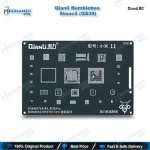
Qianli Bumblebee Stencil (QS39) for Redmi Note 4/4X
₨ 799
QS39 Reballing Stencil for Redmi Note 4/4X
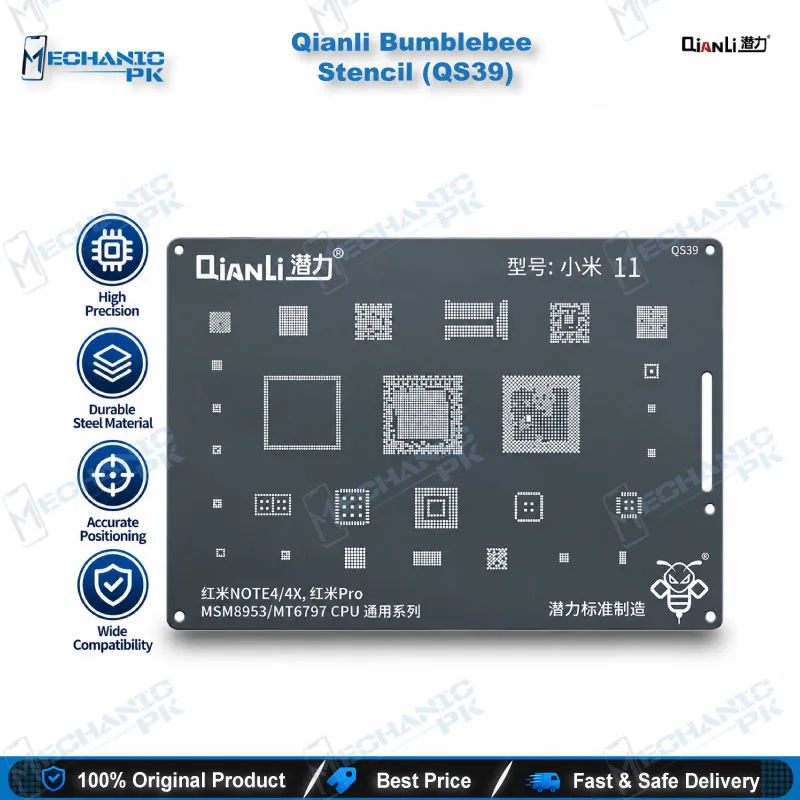
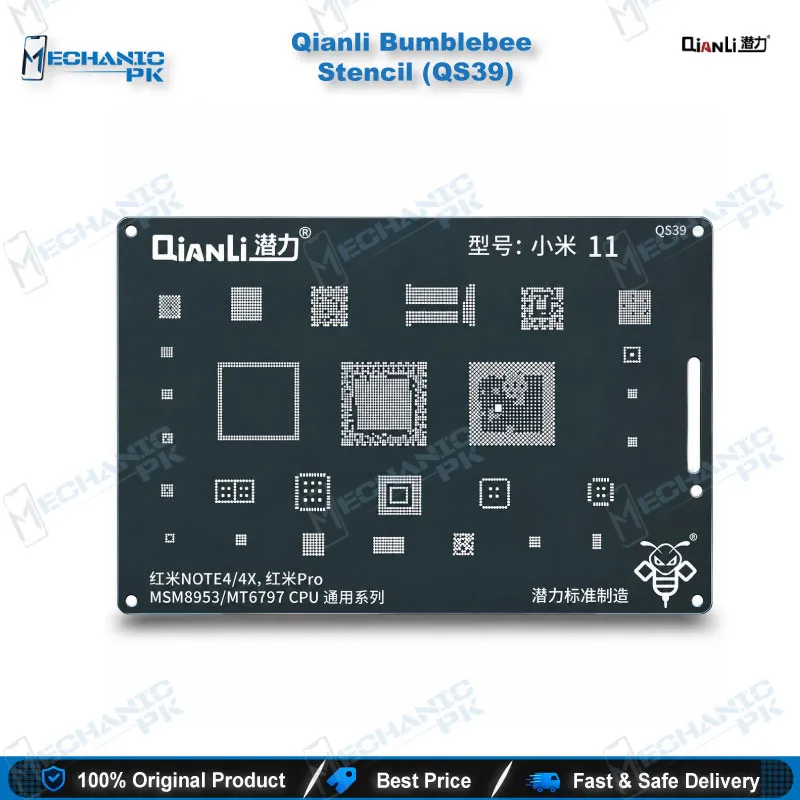
The Qianli Bumblebee Stencil (QS39) covers the MSM8953 and MT6797 CPUs used in the Xiaomi Redmi Note 4, Redmi Note 4X and Redmi Pro. Square holes with rounded corners define each ball position on the CPU pad field, so you rebuild a removed processor with a fixed, repeatable layout. You reball the chip on the bench, then reflow it back onto the board with hot air. Qianli lists this QS39 reballing stencil in its Universal Series, which gives you one tool for two chipset families. Repair shops, service centers and microsoldering technicians in Pakistan use it to recover dead phones with CPU solder faults.
In stock
Qianli QS39 Reballing Stencil for MSM8953 and MT6797 CPUs
The Qianli Bumblebee Stencil (QS39) covers two processor families with one plate: Qualcomm MSM8953 and MediaTek MT6797. Both chips sit inside the Xiaomi Redmi Note 4, Redmi Note 4X and Redmi Pro, and both need a matched stencil once you lift the CPU off the board. This QS39 reballing stencil gives you a defined ball pattern for the CPU package, so you rebuild the solder array from a fixed layout and skip the guesswork over pad positions. Qianli places it in the Bumblebee line of square-hole, round-angle BGA stencils. Mechanicpk supplies it to technicians who already know that a clean CPU reball decides whether a board returns to service or goes back to the customer as scrap.
Square-Hole, Round-Angle Aperture Design
Qianli builds the Bumblebee range around square apertures with rounded corners, and QS39 follows that design. The plate sits flat over the cleaned CPU pad field, you align each aperture to its pad, and you load every opening before reflow. Each aperture defines one ball position, so the finished array matches the original package pattern instead of drifting across the footprint. The plate weighs 14.7 g, which keeps it easy to hold with tweezers and easy to lift away without disturbing the loaded pads. Qianli classes QS39 in its Universal Series, so one stencil serves both the MSM8953 and the MT6797 CPU rather than forcing you to hunt for a separate plate per phone model. Tolerance decides the result here. A plate that sits loose, or apertures that drift off the pad field, produce bridged or missing balls and turn a simple reball into a second rework job. Hold the plate flat against the chip, check alignment under magnification, and confirm every aperture sits over its pad before you apply any heat.
Where QS39 Fits in a CPU Repair Workflow
A CPU stencil earns its place after diagnosis, not before it. You start on the bench with a multimeter and a power supply, because a dead phone or a boot loop issue has many causes, and a reball only helps when the fault sits under the processor. Once you confirm that, a hot air station lifts the CPU, a soldering station and desoldering wick clear old solder from the board and the chip, and a PCB holder keeps the board steady while you work under a microscope. The QS39 reballing stencil enters at that point. You align it to the cleaned chip, form the new balls, and reseat the CPU on the board. A test box or flashing tool then confirms that the phone boots, charges and registers on the network.
Technicians who see a hang on logo or a dead-after-flash phone on these boards often check CPU joints early, because cracked or lifted solder balls can break the signal path between the processor and the board. A model-matched plate keeps that repair repeatable from the first board to the fiftieth.
MSM8953 MT6797 BGA Stencil Scope and Bench Pairing
QS39 lists three Xiaomi models: Redmi Note 4, Redmi Note 4X and Redmi Pro. It lists two CPUs: Qualcomm MSM8953, the Snapdragon 625 platform, and MediaTek MT6797, the Helio X20 platform. Read the CPU marking on your board before you reach for the stencil, because the plate follows the chip package and not the phone name. Keep QS39 for these two chipsets; any other CPU needs its own matching stencil.
Build the rest of the bench around it. A reballing kit supplies the solder and tools, a hot air station controls reflow, a soldering station handles pad cleanup, and a microscope lets you check every ball before you close the board. Service centers and repair shops across Pakistan that handle Xiaomi boards keep a model-matched stencil like QS39 within reach, so a CPU reball never waits on a missing part.
| Weight | 0.14 kg |
|---|
Key Features
- Covers both MSM8953 and MT6797 CPU packages in one plate
- Fits the Xiaomi Redmi Note 4, Redmi Note 4X and Redmi Pro
- Square holes with rounded corners from Qianli’s Bumblebee BGA design
- Universal Series model code QS39 for easy identification and reorder
- Lightweight 14.7 g plate that handles easily with tweezers
- Defined ball layout for repeatable CPU reballing
- Sturdy, precision-built stencil from the Qianli Bumblebee range
- Slots into a standard workflow with hot air station, PCB holder and microscope
Specifications
| Brand | Qianli |
|---|---|
| Model | QS39 |
| Category | BGA Reballing Stencil (Bumblebee Series) |
| Compatibility | Xiaomi Redmi Note 4 / Redmi Note 4X / Redmi Pro, MSM8953 / MT6797 CPU, Universal Series |
| Supported Devices | Xiaomi Redmi Note 4, Redmi Note 4X, Redmi Pro |
| Technology | Square holes, round angle BGA stencil |
| Weight | 14.7 g |
Common Repair Uses
- CPU-level reballing on Xiaomi boards that carry the MSM8953 or MT6797 processor
- CPU reballing after hot air removal
- Rebuilding the ball array on a cleaned MSM8953 or MT6797 chip
- CPU replacement preparation for dead phone boards
- Reflow repair for cracked or lifted CPU solder joints
- Reballing work on boards that hang on logo or fail to boot because of a CPU hardware fault
- Repair bench workflow alongside a hot air station, PCB holder and microscope
Compatible Devices
- Xiaomi Redmi Note 4, Note 4X and Redmi Pro, covering MSM8953 and MT6797 CPU packages
- Xiaomi Redmi Note 4
- Xiaomi Redmi Note 4X
- Xiaomi Redmi Pro
- Qualcomm MSM8953 CPU (Snapdragon 625 platform)
- MediaTek MT6797 CPU (Helio X20 platform)
FAQ
What is the product name?
What is the brand of this product?
What is the model of this product?
What is this product used for?
Which devices are compatible with this product?
Who should use this product?
Which CPUs does the Qianli QS39 stencil support?
Can I use QS39 on other Xiaomi phones or other Qualcomm and MediaTek chips?
Related products