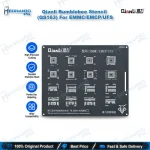
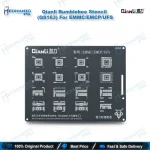
Qianli Bumblebee Stencil QS163 for eMMC/eMCP/UFSm
₨ 1
QS163 Bumblebee Stencil for Storage Chips
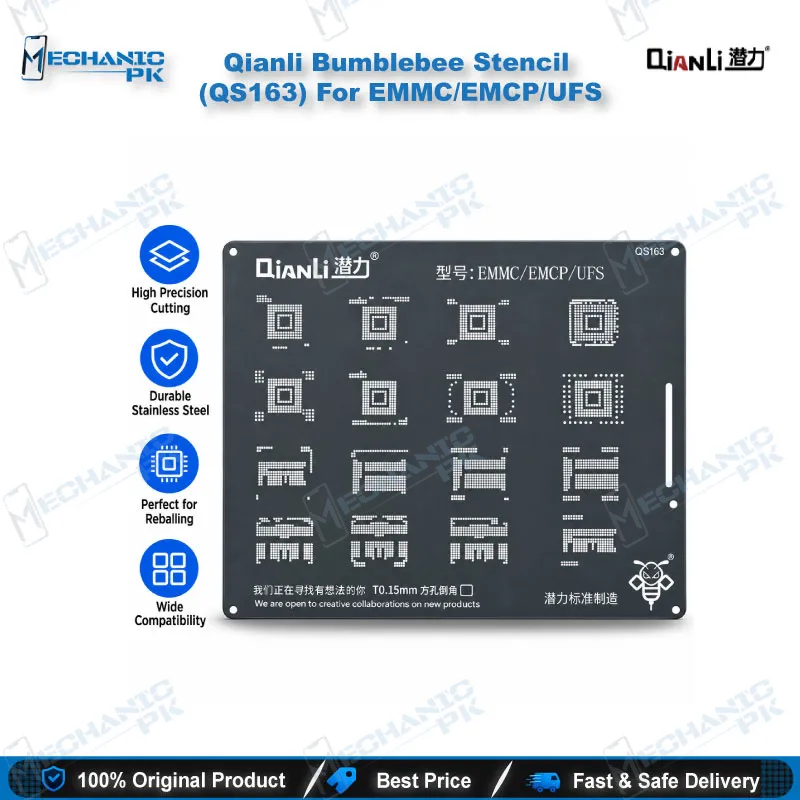
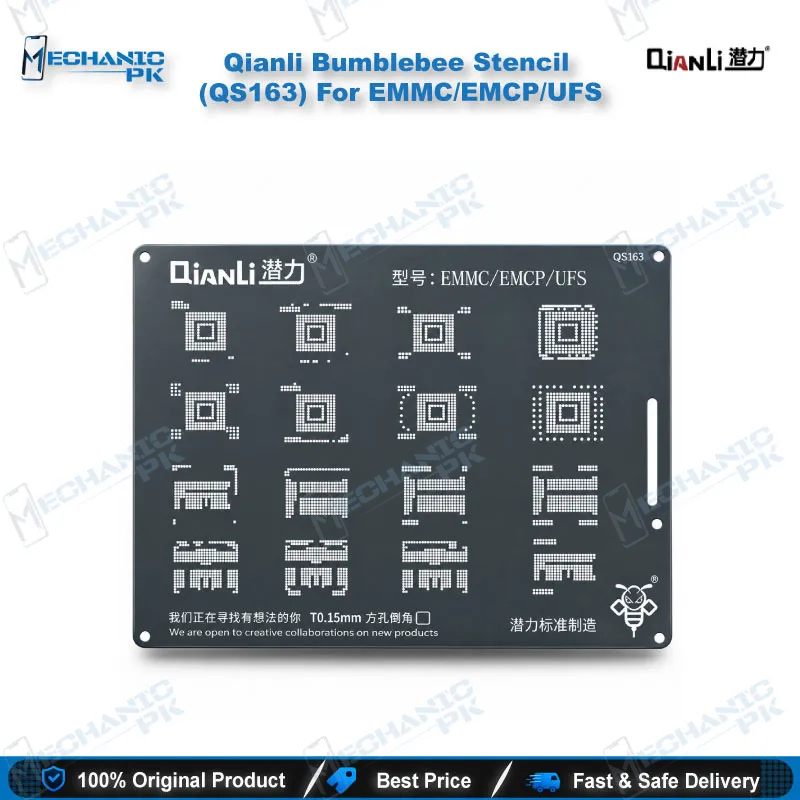
The Qianli QS163 Bumblebee Stencil gives your bench a dedicated BGA template for reballing eMMC, eMCP and UFS storage chips. Square holes with rounded corners keep each solder ball position repeatable, so you stop eyeballing balls on a chip that decides whether a dead phone boots again. Pair it with a hot air station, a microscope and a PCB holder to build a clean storage-chip workflow. Mechanicpk supplies the QS163 in Pakistan for technicians, service centers and repair shops that handle board-level storage repair every day.
Out of stock
Qianli QS163 Bumblebee Stencil for eMMC, eMCP and UFS Reballing
The Qianli QS163 Bumblebee Stencil is a purpose-built BGA reballing template for the storage chips that sit at the center of most dead-phone and boot-loop jobs. Qianli lists it for eMMC, eMCP and UFS, which covers the storage packages you pull off Android boards in a typical repair queue. Mechanicpk stocks it for technicians who want exact ball placement instead of hand-dotted solder.
Where the QS163 fits in storage-chip repair
Storage faults rarely announce themselves cleanly. A phone hangs on logo, dies after flash, or refuses every box you connect, and the diagnosis ends at the storage IC. Once you confirm the fault, you lift the chip, clean it and reball it. The QS163 handles the reballing step. It sits between your ISP or eMMC programmer work and the final resolder, so a chip you re-read, re-write or replace goes back onto the board with a fresh, uniform ball array.
If you work with ISP pinout tools, eMMC programmers or UFS adapters, you already know the programming side. The stencil closes the hardware side of the same workflow.
Stencil design and build
Qianli builds the Bumblebee series with square holes and rounded corners, and distributors describe the QS163 as sturdy, precise and durable over repeated use. Square apertures with rounded corners give paste or solder balls a defined seat on each pad. That matters on dense storage packages, where one bridged pair of balls sends you back to the start.
Each unit ships as a single stencil. You supply the paste or balls, the flux and the heat source, and you choose the method that suits your bench.
Reballing workflow with the QS163
You start by removing the chip with your hot air station, then clean the pads on both the chip and the board with a soldering station, flux and solder wick. Hold the board steady in a PCB holder, because a board that shifts mid-job ruins alignment.
Place the cleaned chip under your microscope and match its ball map to the stencil apertures. Every pad needs a matching hole before you commit. Apply paste or balls, apply heat evenly, then lift the stencil once the balls set. Inspect the result under magnification, check for missing or bridged balls, and reflow the chip onto the board.
After resoldering, test the board with a multimeter for shorts on the supply rails before you power it. Then reconnect your test box or programmer and confirm the chip responds.
Why technicians choose a Bumblebee stencil for storage jobs
Reballing by hand works until it does not. One uneven ball turns IC change karna into a second and third attempt, and each attempt stresses the pads. A fixed stencil removes the guesswork. You get the same ball layout on the first chip and the fiftieth.
The QS163 suits shops that see eMMC and UFS jobs daily: boot loop issues, hang-on-logo faults, dead phones after a failed flash, and storage swaps on boards where the original chip lost its data path. For heavier volume, explore the Reballing Kits and Hot Air Stations categories on Mechanicpk to build a full bench around it.
| Weight | 0.1 kg |
|---|
Key Features
- Dedicated eMMC, eMCP and UFS reballing template
- Square holes with rounded corners for defined ball seating
- Repeatable ball layout across multiple chips
- Sturdy, precise build described as durable with repeated use
- Single-stencil unit for bench-ready storage reballing
- Works alongside hot air stations and soldering stations
- Fits workflows built around microscopes and PCB holders
- Supports chip reuse and chip replacement jobs
Specifications
| Brand | Qianli |
|---|---|
| Model | QS163 |
| Category | BGA Reballing Stencil (Bumblebee Series) |
| Compatibility | eMMC, eMCP and UFS chips |
| Technology | Square-hole, round-corner BGA stencil |
| Package Contents | 1x Stencil |
Common Repair Uses
- Reballing eMMC chips after chip-off removal
- Reballing eMCP chips on dead or boot-loop boards
- Reballing UFS chips after programming or data recovery work
- Preparing a replacement storage chip for resoldering
- Fixing hang-on-logo faults traced to storage
- Recovering dead-after-flash phones where the storage chip needs a reflow
- Restoring uniform ball arrays after pad cleaning
- Training new technicians on repeatable BGA reballing
Compatible Devices
- Devices: Android phones and tablets whose boards use eMMC, eMCP or UFS storage chips (compatibility scope is by chip type, not by individual phone model)
- eMMC storage chips on Android boards
- eMCP combined memory and storage chips
- UFS storage chips
- Samsung, Oppo, Vivo, Infinix and Tecno boards that use eMMC, eMCP or UFS storage (confirm chip layout first)
- Any board where you match the chip's ball map to the stencil apertures
- Boards where you remove and reball the storage chip for reuse
- Boards where you replace a failed storage chip with a new one
- Workflows that follow ISP or chip-off storage diagnosis
FAQ
What is the product name?
What is the brand of this product?
What is the model of this product?
What is this product used for?
Which devices are compatible with this product?
Who should use this product?
Which chip types does the QS163 stencil support?
How do I confirm the QS163 fits my chip before reballing?
Related products