
















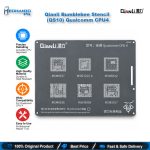
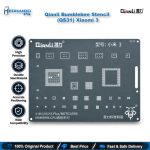
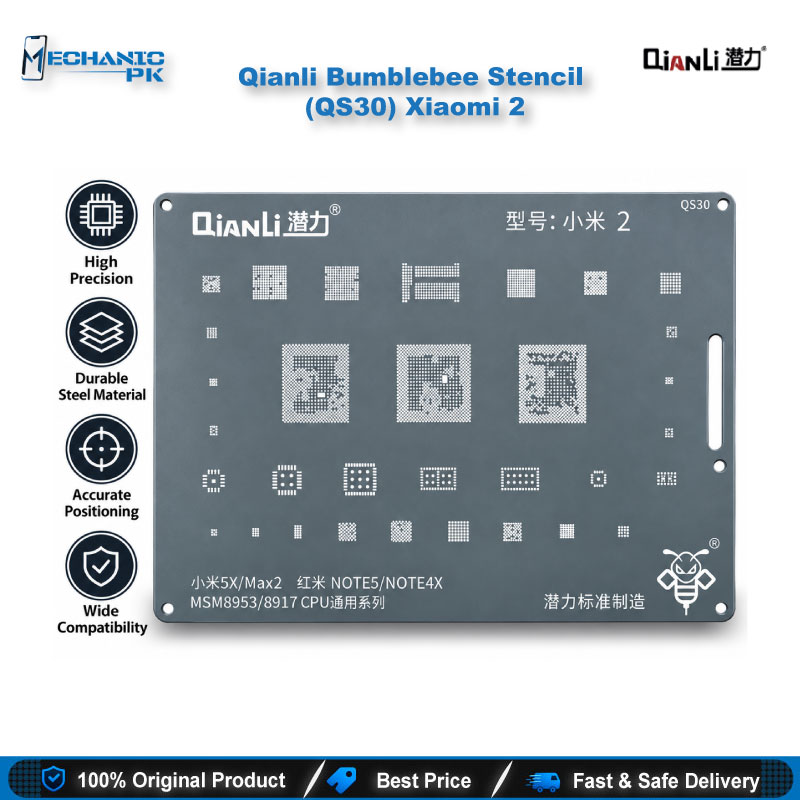
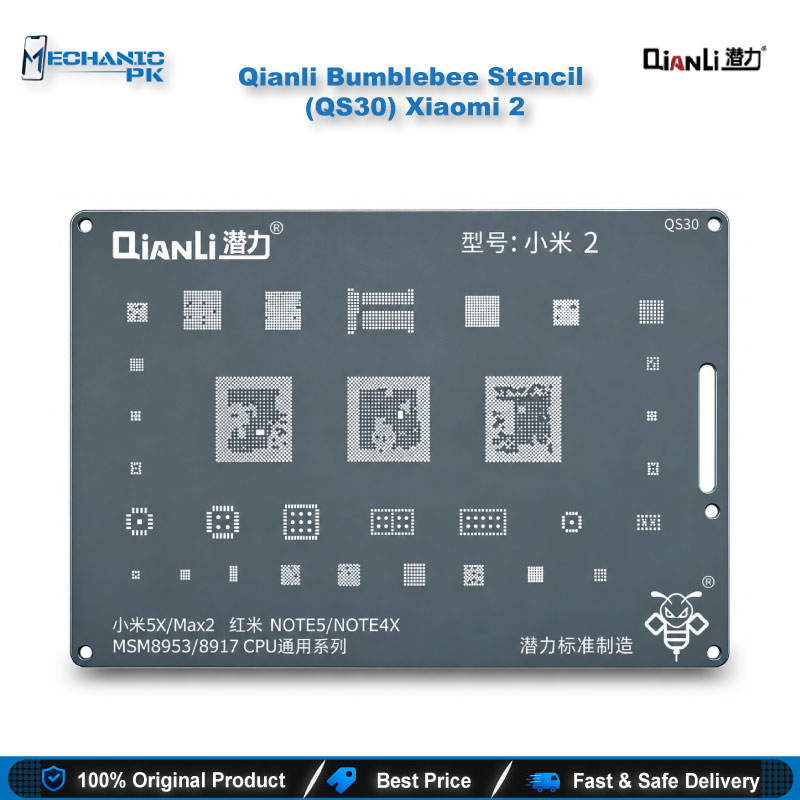
Qianli Bumblebee Stencil (QS30) Xiaomi 2 BGA Reballing
₨ 799
Qianli QS30 Reballing Stencil for Xiaomi MSM8953 and MSM8917 Boards
The Qianli Bumblebee Stencil (QS30) Xiaomi 2 gives you a chipset-matched BGA reballing plate for Qualcomm MSM8953 and MSM8917 CPUs. Qianli lists it for the Xiaomi 5X, Mi Max 2, Redmi Note 5 and Redmi Note 4X. You align it over a cleaned CPU, apply solder balls or paste, and reflow for an even ball grid before you refit the chip. Pair it with a hot air station, reballing kit and microscope to finish CPU repairs on a dead phone or a hardware fault board. Mechanicpk supplies it to technicians, repair shops and service centers across Pakistan.
In stock
Qianli QS30 Reballing Stencil for MSM8953 and MSM8917 Boards
The Qianli Bumblebee Stencil (QS30) Xiaomi 2 is a Qianli QS30 reballing stencil that covers the Qualcomm MSM8953 and MSM8917 CPU universal series. Qianli lists this pattern for the Xiaomi 5X, Mi Max 2, Redmi Note 5 and Redmi Note 4X, so one plate serves every board that shares these two chipsets. You reach for it when a CPU comes off a dead phone and the pads need fresh solder balls before the chip goes back on. This page gives you the verified scope, the repair workflow it belongs to, and the bench tools that pair with it.
Where the QS30 Fits in a CPU Reball Workflow
CPU reballing starts after you lift the chip with a hot air station and clean both the board pads and the chip underside with flux and desoldering wick. The stencil comes next. You align the QS30 openings over the clean CPU, hold the chip steady in a reballing platform or PCB holder, and spread solder paste or drop solder balls through the holes. A short pass of heat melts the balls into place, and the plate lifts away once it cools. The result is an even ball grid that matches the pad layout on the MSM8953 or MSM8917 package. Technicians use this step on a hardware fault where reflow alone does not bring the board back, for example when a drop or heat damage leaves cracked CPU joints. Overheating lifts pads, so set your hot air temperature and airflow before you start and keep the nozzle moving. Clean flux residue off the chip before you refit it, because leftover residue hides bridges under the microscope. Check the chip under a microscope after reballing, then test the board’s power draw before you close the device.
Qianli Bumblebee Series Design and Chipset Matching
The QS30 belongs to Qianli’s Bumblebee range of BGA stencils, which Qianli sells under the ToolPlus 2D Bumblebee name. Series listings describe square holes with rounded angles, a layout that lets solder balls settle into each opening and release cleanly from the plate. Qianli names every Bumblebee stencil with a QS number, so you match the code to your chipset family instead of guessing by phone name. QS29 targets Qualcomm 636 and 660 boards, QS35 targets MSM8998 boards, and QS30 targets MSM8953 and MSM8917. That makes the QS30 a chipset-specific tool, not a general-purpose grid. The plate holds a fixed pattern, so your MSM8953 reballing stencil earns its place by working across many jobs. Wipe it with cleaner after every reball, because dried paste in the openings blocks balls on the next chip. Label each plate on your bench and store it by code, because a similar-looking stencil with a different pattern will not seat the balls correctly on your CPU.
Buying Notes for Repair Shops and Service Centers
If your shop handles Xiaomi and Redmi boards every day, the QS30 covers two Qualcomm chipsets that return to the bench again and again. Match your stock to the units that walk in: Redmi Note 4X, Redmi Note 5, Xiaomi 5X and Mi Max 2 jobs that need CPU work. Build a complete reball station around it with a reballing kit, a hot air station, a soldering station, a PCB holder and a microscope, so you finish the whole job without borrowing tools. As your volume grows, you can move from a basic setup to a hot air station with finer airflow control and a stronger microscope. Boards with storage faults follow a different path, so browse the eMMC programmers and ISP pinout tools categories for that work. For training institutes, the QS30 gives students a clear, repeatable practice piece for learning BGA reballing on real Qualcomm packages.
| Weight | 0.1 kg |
|---|
Key Features
- Chipset-matched pattern for the MSM8953 and MSM8917 CPU universal series
- Part of Qianli's ToolPlus 2D Bumblebee stencil range
- Square holes with rounded angles, as the Bumblebee series describes
- Single plate that serves Xiaomi 5X, Mi Max 2, Redmi Note 5 and Redmi Note 4X boards
- Works with solder balls or solder paste through the openings
- Fits a standard reball workflow with a hot air station, reballing platform and PCB holder
- QS-number coding that lets you match stencil to chipset quickly
- Reusable plate for repeated CPU reballing jobs
Specifications
| Brand | Qianli |
|---|---|
| Model | QS30 |
| Category | BGA Reballing Stencil (Bumblebee Series) |
| Compatibility | Qualcomm MSM8953 / MSM8917 CPU Universal Series |
| Supported Devices | Xiaomi 5X, Xiaomi Mi Max 2, Redmi Note 5, Redmi Note 4X |
| Technology | Bumblebee Series BGA reballing stencil |
Common Repair Uses
- Real-world reballing workflows for MSM8953/MSM8917 boards
- CPU reballing after hot air removal
- Re-forming the ball grid on a CPU before refitting it to the board
- Preparing a removed CPU for reuse on a replacement board
- Repairing cracked CPU joints after a drop or heat damage
- Hands-on BGA reballing practice in technician training
Compatible Devices
- Verified chipset-family scope as listed by Qianli distributors
- Xiaomi 5X
- Xiaomi Mi Max 2
- Redmi Note 5
- Redmi Note 4X
- Qualcomm MSM8953 CPU
- Qualcomm MSM8917 CPU
FAQ
What is the product name?
What is the brand of this product?
What is the model of this product?
What is this product used for?
Which devices are compatible with this product?
Who should use this product?
Which CPU chipsets does the Qianli QS30 stencil support?
Is the QS30 the same stencil as the QS29 or QS35?
Related products