
















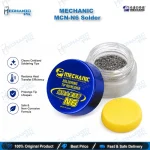
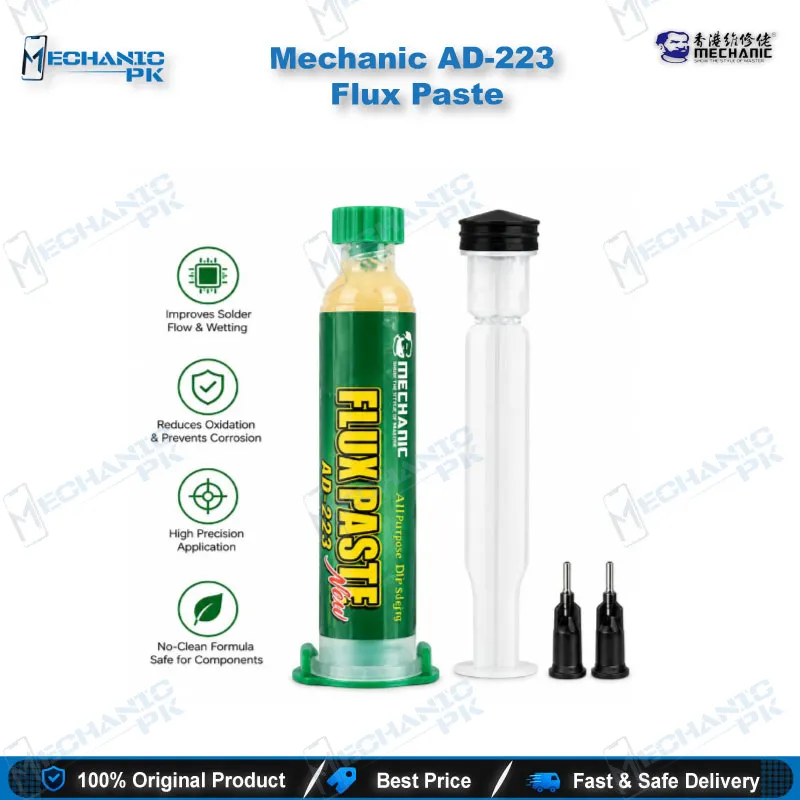
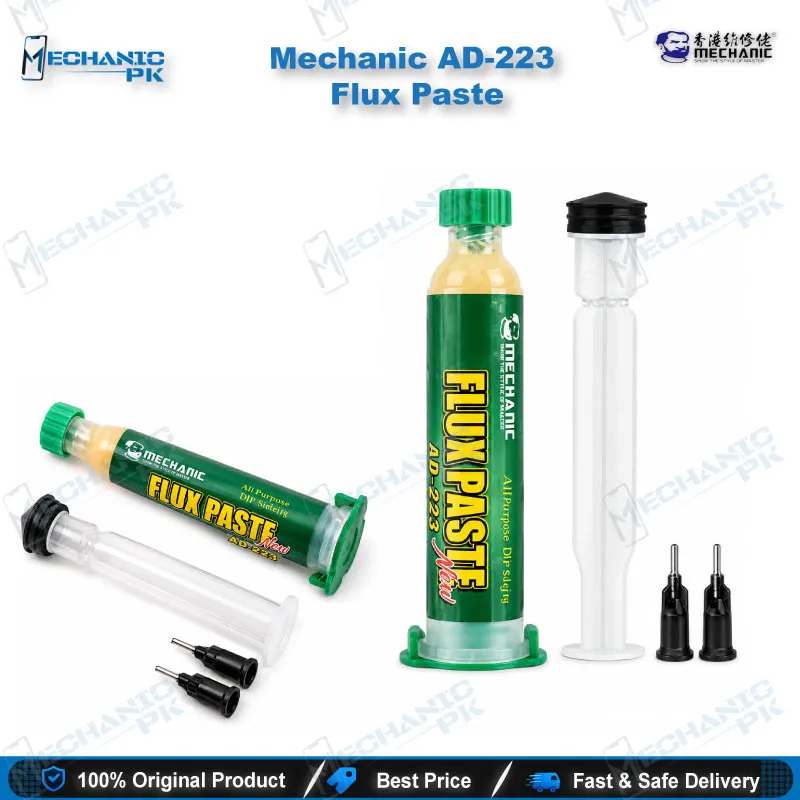
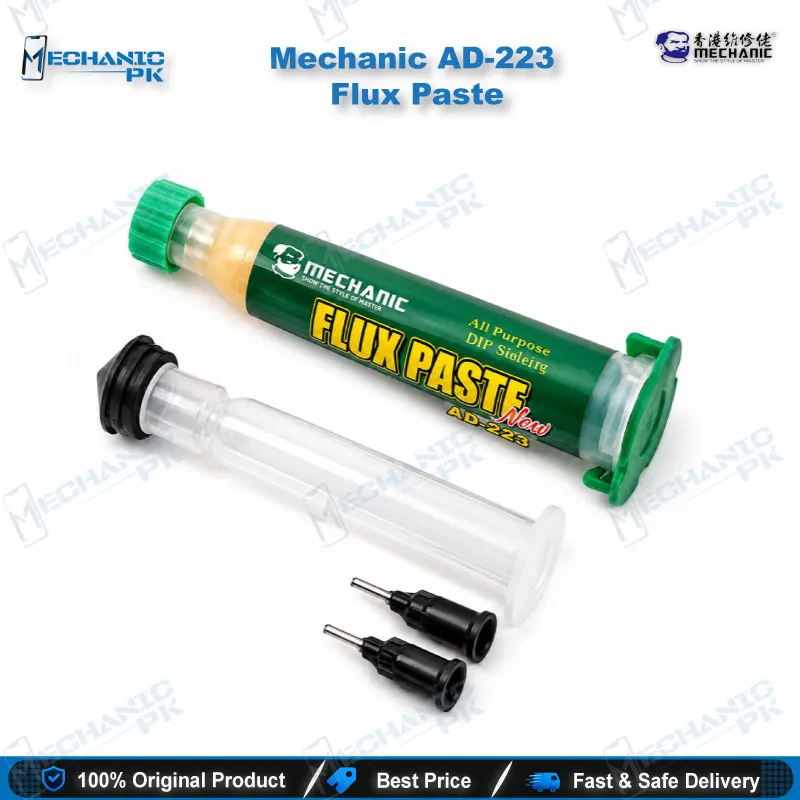
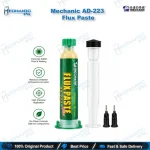
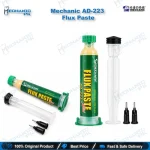
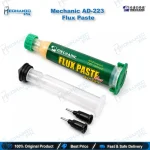
Mechanic AD-223 Lead-Free No-Clean BGA Flux Paste 10cc
₨ 1
H2: Mechanic AD-223 No-Clean BGA Flux Paste 10cc
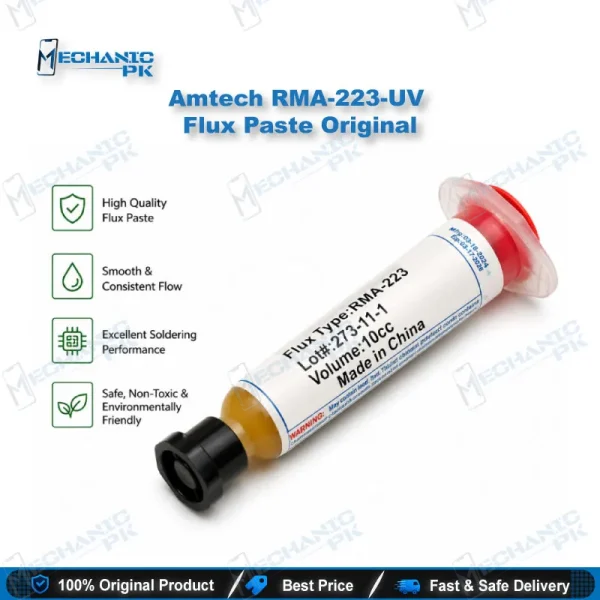
The Mechanic AD-223 is a lead-free, no-clean flux paste for BGA reballing and chip-level rework on phone and computer boards. Its high-viscosity formula stays where you place it, and the alloyed solder powder mixed into the paste helps joints form cleanly with less pale yellow residue. You get a 10cc tube with a needle tip, so you control how much flux reaches each pad. Use it as your flux step for reflowing BGA and PGA packages, or for SMD work on motherboards.
Out of stock
H2: No-Clean BGA Flux Paste for Reballing and Chip-Level Repair
Every reballing job depends on how the flux behaves before the solder ever melts. The Mechanic AD-223 is a lead-free, no-clean BGA flux paste that gives your repair bench a predictable starting point. It combines a resinous paste flux with alloyed solder powder, so the material holds its shape on the pads and wets the balls evenly once heat arrives. Because the flux is no-clean, you spend less time washing boards and more time testing them. Technicians working on phone CPUs, baseband chips, and computer chipsets will find it fits the standard BGA and PGA reworking steps. The sections below cover where this paste sits in your workflow, how it handles residue, and which package suits your bench.
H3: Where AD-223 Fits in Your BGA Workflow
A clean reballing sequence follows a simple order: remove the old solder, clean the pad field, apply flux, place the balls or reflow the package, then inspect the joints. The AD-223 belongs in the flux step. Apply a thin, even layer across the pads or the ball field instead of a heavy bead, because excess paste can bridge neighboring balls once heat reaches the package. This matters most on dense phone boards, where a single bridge can turn a simple IC change karna job into a board you have to strip again. Your steps stay the same whether you run a hot air station or a reflow setup, since the paste changes how the solder wets rather than how you handle the board. Use the needle tip for small pad fields, and keep the flux off surrounding passive components so they do not pick up residue during heating.
H3: Residue, Cleanup, and Pad Protection
The main advantage of a no-clean paste is how little work it leaves behind. The manufacturer describes residue that peels off by hand or with tweezers, which saves solvent and bench time on every board. The paste also avoids the pale yellow film that can hide joints and complicate visual inspection after reflow. Pad protection matters on phone boards, where gold, copper, and bronze contacts can corrode once exposed to air and moisture. The AD-223 is marketed to avoid oxidizing these metals, so freshly cleaned pads stay bright through the reflow window. Even so, inspect the board under a microscope after reflow. Remove any residue near connectors or fine SMD parts before you power the board, because stray material in those areas can still affect a test.
H3: Choosing the Right Package and Storing It
The 10cc package gives you a practical volume for a working bench, and it comes with a needle tip for precise dispensing. Its high-viscosity consistency keeps the paste in place on the pads rather than running into surrounding components. That matters when you work around tight clearances on a motherboard, where loose flux can migrate under nearby parts during heating. Cap the syringe between jobs, because a paste left open can thicken and become harder to dispense accurately. Store it in a cool place away from direct heat, and wipe the tip before each use so the next application stays consistent. Whether you run a few boards a day or a full service center workload, a single tube format makes usage easy to track, so you can reorder before a repair stalls on an empty syringe.
| Weight | 0.9 kg |
|---|
Key Features
- Lead-free formula suited to modern BGA reballing
- No-clean residue that peels off by hand or tweezers
- High-viscosity paste that stays on the pads
- Alloyed solder powder mix that reduces pale yellow residue
- Strong joint intensity with good immersion, per manufacturer data
- Designed not to oxidize gold, copper, bronze, or phosphorus contacts
- Includes a needle tip for controlled dispensing
- 10cc tube for everyday bench use
Specifications
| Brand | Mechanic |
|---|---|
| Model | AD-223 |
| Category | BGA Soldering Flux Paste |
| Compatibility | BGA, PGA, and SMD packages on mobile phone and computer boards |
| Supported Devices | Mobile phone and computer motherboard chips |
| Technology | Lead-free, no-clean paste flux (flux type UV-223) |
| Material | Resinous paste flux mixed with alloyed solder powder |
Common Repair Uses
- Chip-level reballing and board-level BGA and SMD rework
- Reballing BGA chips after removing the old solder balls
- Reflowing BGA ICs during chip replacement
- Re-tinning pads before placing a replacement IC
- Repairing weak BGA joints on boards showing a dead phone or boot loop fault
- Reworking PGA sockets and packages on computer boards
- Soldering SMD components on mobile phone PCBs
- Restoring lifted or weak joints during charging issue repair
- Chip-level PCB rework and jumper joint repair
Compatible Devices
- Universal for BGA, PGA, and SMD packages; not device-specific
- Phone CPU and baseband BGA packages
- Computer chipsets with BGA packages
- PGA packages on computer boards
- SMD components on mobile phone PCBs
- Mobile phone motherboard BGA ICs
- PCB motherboards for phone and computer repair
- Lead-free BGA reballing workflows
- Board-level SMD and BGA rework
FAQ
What is the product name?
What is the brand of this product?
What is the model of this product?
What is this product used for?
Which devices are compatible with this product?
Who should use this product?
Is AD-223 lead-free and no-clean?
Does AD-223 leave residue on gold or copper pads?
Related products