














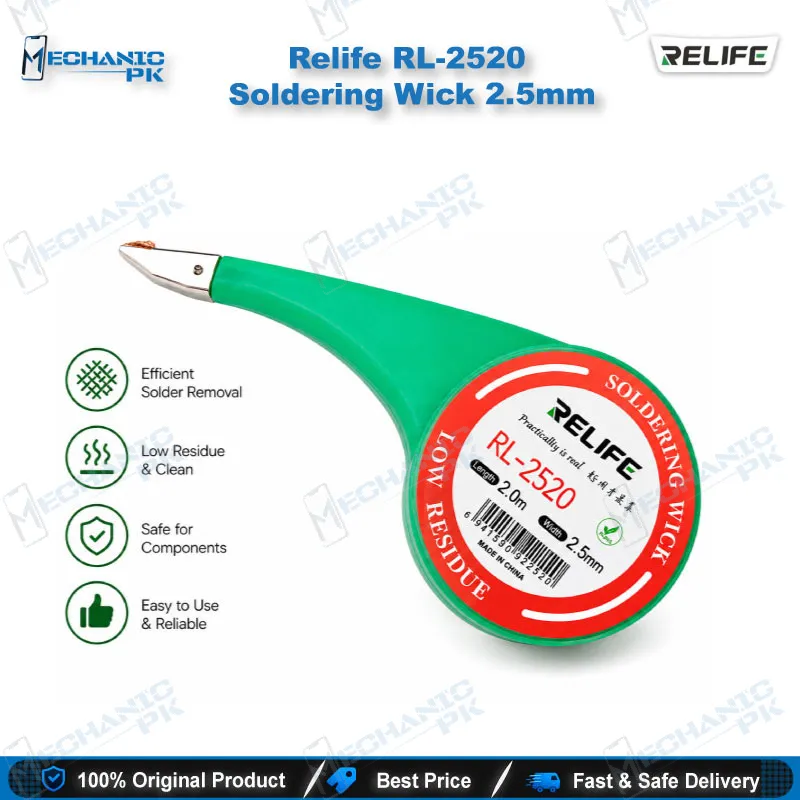
Relife RL-2520 Desoldering Wick 2.5mm
₨ 850
2.5mm Desoldering Wick for Precise Solder Removal
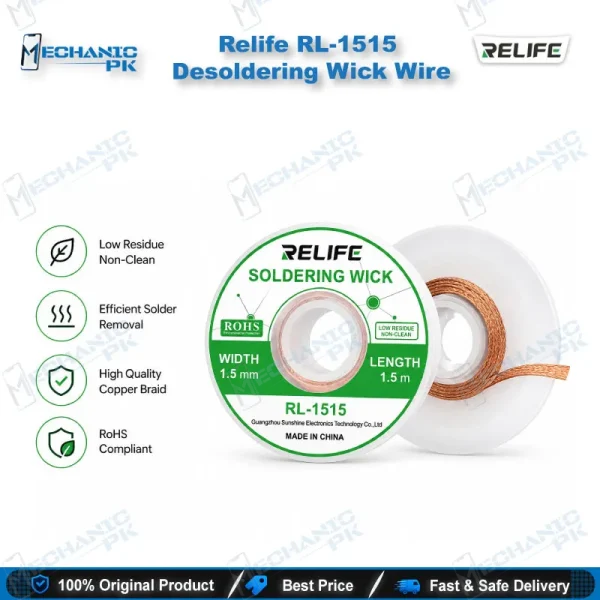
The Relife RL-2520 is a 2.5mm copper desoldering wick with a no-clean residue profile, so you can leave the flux on the board after lifting solder. Its fine braid pulls molten solder in through capillary action, which lets you clear bridged pads and through-hole leads with a short heat contact. A stainless steel mouth and a sealed thumb-wheel dispenser guide the wick to the joint and protect the copper between jobs. Each roll measures 2.0 metres, enough for many separate joints on a phone board, connector or small SMD area.
Out of stock
Relife RL-2520 2.5mm Desoldering Wick for Board-Level Repair
The Relife RL-2520 suits technicians who need a width that handles connector pins, mid-size SMD pads and through-hole leads without overwhelming a fine joint. Choose a 2.5mm desoldering wick when the pad is wider than a fine-pitch joint but narrower than a power connector. This model sits between the lighter 1.5mm and 2.0mm braids and the heavier 3.0mm and 3.5mm options in the same Relife range. You use it in the desoldering stage of your workflow, after diagnostics locate a bridge or a lifted component and before you reflow, reball or reseat a part.
Where the 2.5mm Width Fits Your Repair Bench
On a phone motherboard, solder bridges often form between closely spaced pads on a charging connector, an audio jack or a flex socket. A 2.5mm braid covers these pads with enough contact area to lift excess tin in one or two passes. A narrower braid can leave you chasing the last strands, while a wide braid risks pulling solder from neighbouring components. For through-hole leads on older boards, the same width helps you clear each hole before you insert a replacement part. Place the braid over the joint, press a heated tip onto it, and wait until the molten solder climbs into the copper. Lift the iron and the wick together, then cut off the used section before the next pass.
How the No-Clean Braid Behaves on the Bench
The residue from this wick is halide-free and non-conductive, so most boards do not need a cleaning step after the job. That saves time when you clear a row of pads at the end of a long repair session. The copper braid is lightweight, which helps it absorb heat quickly at lower iron temperatures. If a joint looks dull or stubborn, add a small amount of fresh flux before you start, because a light flux coat speeds up the pull. Keep your iron tip clean and tinned, and set the temperature high enough to melt the joint without scorching the laminate. Work in short passes rather than long drags. A long contact time carries heat into the board and can lift a pad, so disciplined timing protects the board as much as the wick does.
Storage, Handling and Pad Protection
The thumb-wheel dispenser has a sealed housing that shields the copper from moisture, which helps the roll last longer on your bench. Store spare rolls in a dry box away from humid environments and keep the dispenser closed when you finish a job. Before each new joint, check the braid for oxidation or flattened sections, and trim any part that has lost its shape. The stainless steel mouth guides the wick and lets you feed it smoothly without bending the braid. Reserve a fresh section for every joint, because a loaded section cannot pull more solder. Never press the wick hard into the copper. Let the heat do the work, and keep each contact short so the pad stays intact.
| Weight | 0.9 kg |
|---|
Key Features
- 2.5mm width for mid-size pads and connector pins
- 100% copper braid for capillary solder pull
- No-clean, halide-free residue that stays non-conductive
- Thumb-wheel dispenser with a sealed housing
- Stainless steel mouth guides the wick to the joint
- 2.0 metre length for many joints per roll
- Sold as a single desoldering wick per package
- Part of the Relife 1.5mm to 3.5mm wick range
Specifications
| Brand | Relife |
|---|---|
| Model | RL-2520 |
| Category | Desoldering Wick |
| Compatibility | Universal, not device-specific |
| Supported Devices | Universal, not device-specific |
| Technology | No-clean, halide-free residue |
| Material | 100% copper |
| Dimensions | 2.5mm width × 2.0m length |
Common Repair Uses
- Removing solder bridges between IC pins
- Clearing charging port pads before replacing the connector
- Cleaning through-hole leads before reinsertion
- Clearing excess tin from SMD resistor pads
- Removing solder from audio jack joints
- Preparing board pads before reflow of a replacement part
- Cleaning flex socket pads during board-level repair
- Desoldering pin headers on PC motherboards
Compatible Devices
- Charging port connector pads on phone boards
- Audio jack and flex socket pads
- Through-hole component leads
- SMD resistor and capacitor pads
- SMD IC pin rows with solder bridges
- PC motherboard through-hole sockets
- Mid-size board-level pads on PCBs
- Universal, fit depends on pad width rather than device model
FAQ
What is the product name?
What is the brand of this product?
What is the model of this product?
What is this product used for?
Which devices are compatible with this product?
Who should use this product?
Does this wick need cleaning after use?
How does the 2.5mm width compare with other Relife sizes?
Related products