
















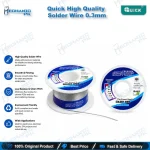
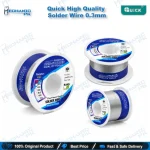
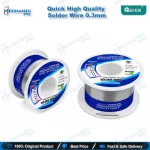
Quick 0.3mm Solder Wire for Mobile Repair 40g
₨ 1
Quick 0.3mm Solder Wire, Sn63Pb37
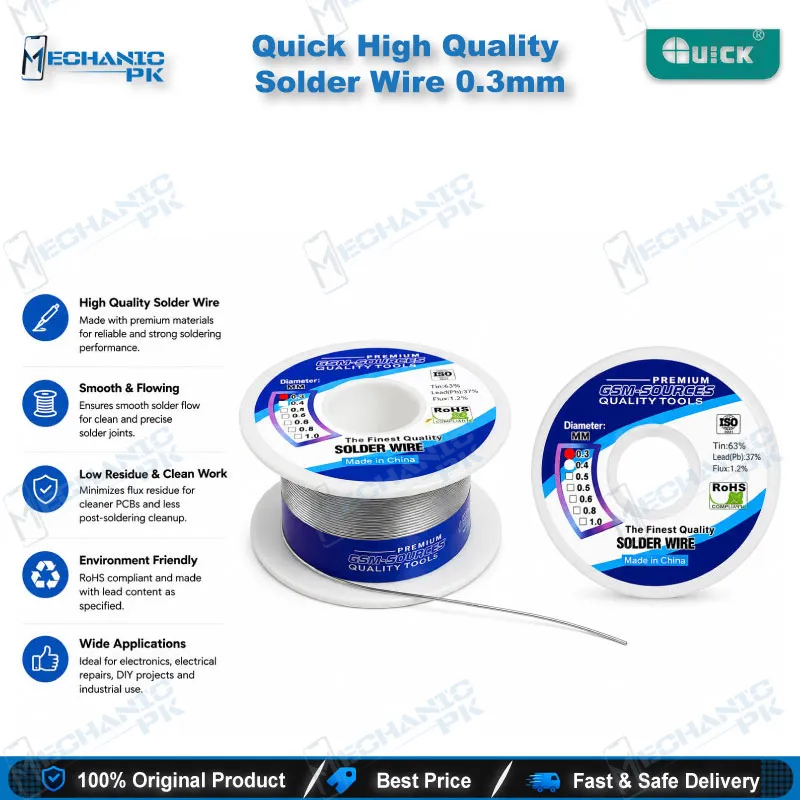
Quick 0.3mm solder wire for mobile repair gives you fine control on dense phone boards. The Sn63Pb37 eutectic alloy melts at one point near 183°C, so each joint sets the moment you lift your iron. The flux core carries 1.0–3.0% flux and cleans the pad as you work, which helps on charging port pads, jumper wire runs, and small IC legs. Pair it with your soldering station, hot air station, and microscope for clean results on dead phone, charging issue, and display problem repairs. Order the 40g spool from Mechanicpk and keep fine-pitch solder at your bench.
Out of stock
0.3mm Solder Wire for Mobile Repair: Fine-Pitch Control on Dense Boards
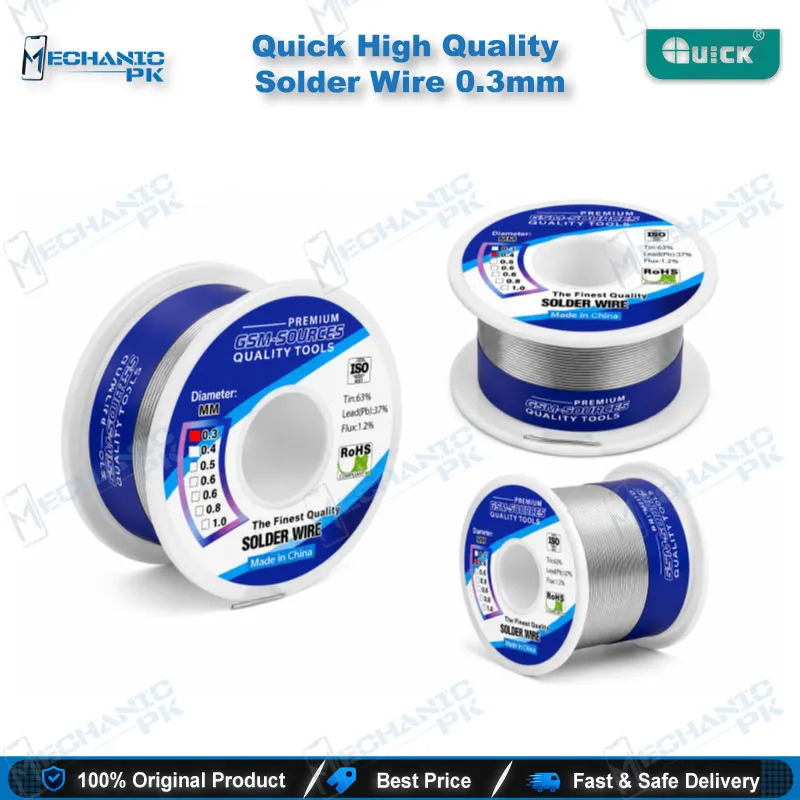
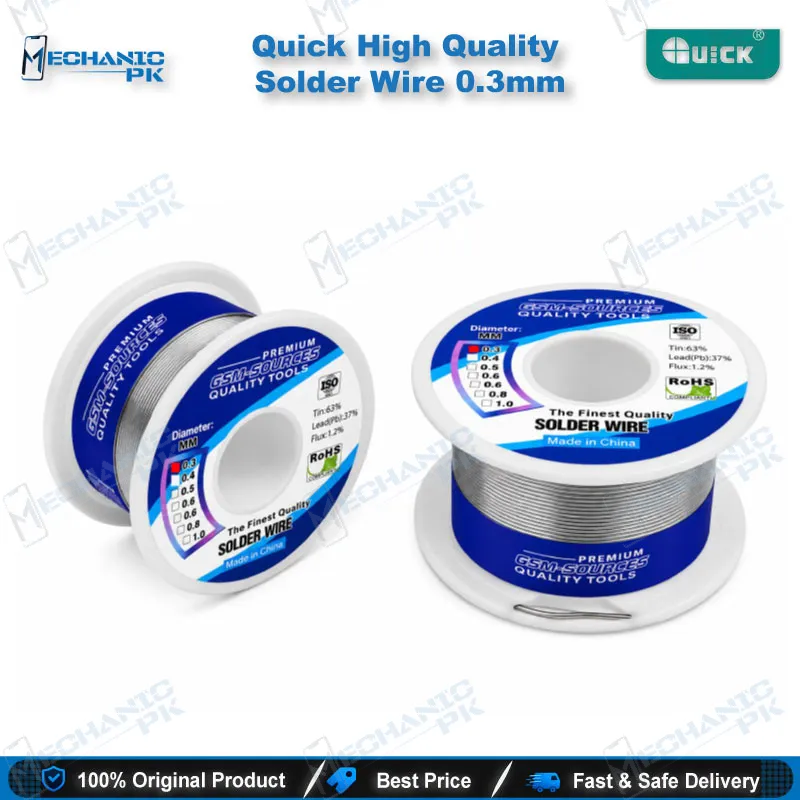
Modern phone boards pack 0402 passives, tight BGA pitches, and thin flex pads into a few square centimetres. A 0.3mm solder wire for mobile repair lets you place solder on those pads in small, controlled amounts instead of flooding them. Quick supplies this wire in Sn63Pb37 alloy on a 40g spool with a flux core. You get a eutectic filler that melts at one temperature and flows cleanly into the joint. Mechanicpk lists it for technicians who need predictable results on charging ports, jumper wire runs, and pad repair.
Why Sn63Pb37 Suits Board-Level Work
Sn63Pb37 sits at the eutectic point of the tin-lead system. The alloy turns from solid to liquid at one temperature, around 183°C, with no pasty range in between. That matters when you work beside heat-sensitive parts. The joint freezes the moment you lift the iron, so you avoid the dull, grainy joints that form when solder cools slowly through a plastic range. You also run your iron cooler than lead-free work demands, which lowers the risk of lifting pads on a board that already carries a hardware fault.
The flux core carries 1.0–3.0% flux. It strips oxide off the pad as the wire melts, so routine touch-ups rarely need extra paste flux. The alloy contains 37% lead, so you work with ventilation and wash your hands after handling the spool. If a job requires lead-free solder, choose a different wire.
Where the 0.3mm Diameter Earns Its Place
Thick wire forces you to guess. A 1mm wire dumps too much solder on a USB-C or micro-USB pad, and you spend the next ten minutes wicking excess and clearing bridges. The 0.3mm diameter gives you a small, visible bead with each touch of the iron.
You tin a lifted pad, reflow a cold joint on a charging port, tack a jumper wire onto a broken trace, or refresh the legs of a small IC after IC change karna. Under a microscope you see exactly how much solder you feed, and you stop before a bridge forms. For jumper lagana on a damaged track, the thin wire lets you drop a controlled bead on the jumper end instead of a blob that spreads across neighbouring pads.
Fitting It Into Your Repair Workflow
Each joint on a phone board uses only a few millimetres of wire, so the 40g spool lasts a long time at a busy bench. Pair it with a temperature-controlled soldering station, a fine conical or bevel tip, and a PCB holder that locks the board in place. During hot air work, such as reflowing a connector or tacking a shield, the wire adds solder to the pads before you place the part. When you prepare a board for reballing, use the wire to build up thin pads, and keep your reballing kit for the BGA stencil and ball work.
After every joint, check continuity with a multimeter before you power the board. Technicians who fix charging issue, display problem, and network issue faults reach for this wire daily, because nearly every one of those repairs ends with a small solder joint. Shops with several benches often keep one spool per technician, so nobody stops mid-repair to hunt for solder. Store the spool in a dry drawer to keep the wire clean and bright. If you also repair larger power-line pads, keep a thicker 0.6mm or 0.8mm spool beside it and save the 0.3mm wire for fine-pitch work.
| Weight | 0.1 kg |
|---|
Key Features
- 0.3mm diameter for fine-pitch pad work
- Sn63Pb37 eutectic alloy with a single melting point
- Flux core with 1.0–3.0% flux content
- Bright, smooth joints on clean pads
- 40g spool for steady bench supply
- Suits soldering stations and hot air rework
- Works under a microscope with tight control
- Universal use across phone brands
Specifications
| Brand | Quick |
|---|---|
| Category | Soldering Wire |
| Compatibility | Universal, not device-specific; suits any board that accepts leaded solder |
| Technology | Sn63Pb37 tin-lead eutectic alloy with flux core |
| Material | Tin-lead alloy (Sn 63%, Pb 37%) |
| Diameter | 0.3mm |
| Flux Content | 1.0–3.0% |
| Melting Point | 183°C (Sn63Pb37 eutectic) |
| Packaging | Spool |
| Dimensions | 55 x 55 x 27.6 mm |
| Weight | 40g |
Common Repair Uses
- Fine-pitch soldering on mobile phone boards.
- Charging port pad repair
- Jumper wire soldering on broken traces
- Tinning lifted or bare pads
- Reflowing cold joints
- IC leg soldering after IC change
- Connector and FPC pad touch-ups
- Shield and small component re-attachment
- Pad preparation before reballing
Compatible Devices
- Universal solder consumable. It works on any phone board that accepts leaded solder, so no device-specific restriction applies.
- Samsung Galaxy series boards
- Oppo and Realme boards
- Vivo boards
- Infinix boards
- Tecno boards
- Xiaomi and Redmi boards
- Huawei boards
- iPhone series boards
FAQ
What is the product name?
What is the brand of this product?
What is the model of this product?
What is this product used for?
Which devices are compatible with this product?
Who should use this product?
At what temperature does Quick Sn63Pb37 0.3mm solder wire melt?
Is this 0.3mm solder wire lead-free?
Related products