














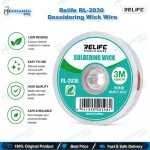
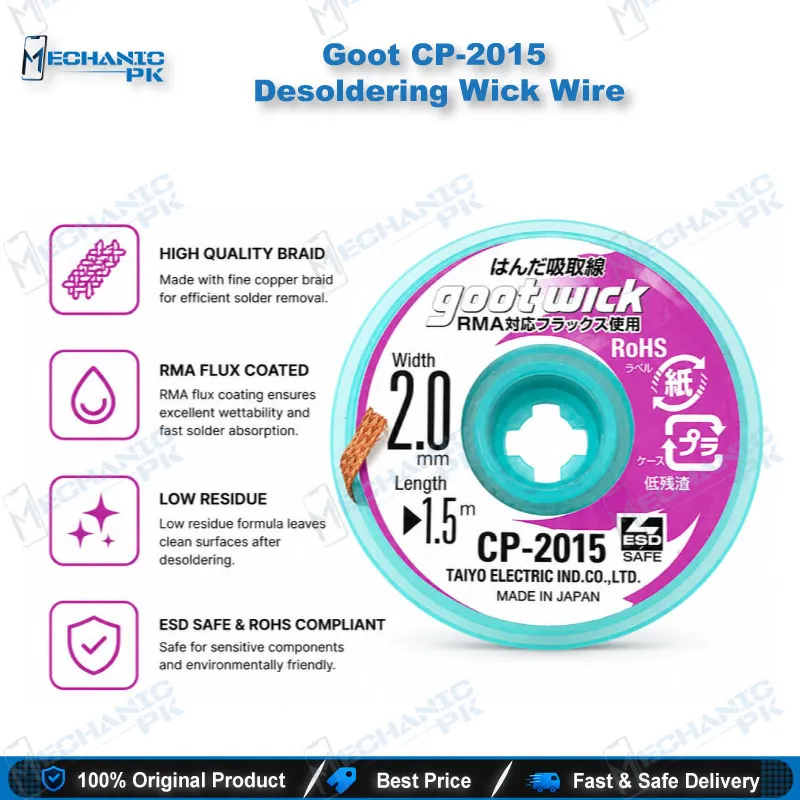
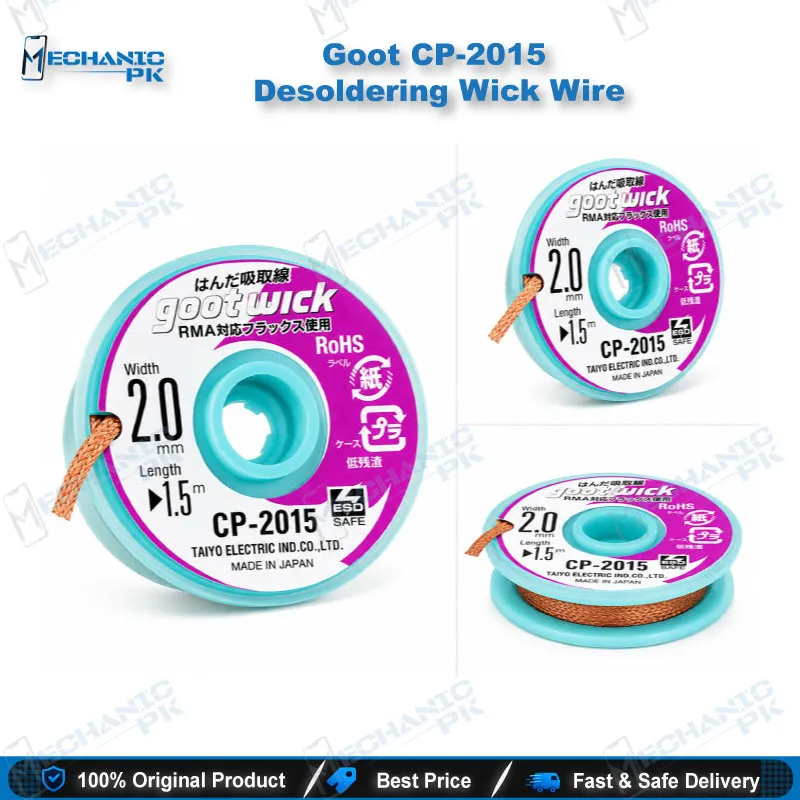
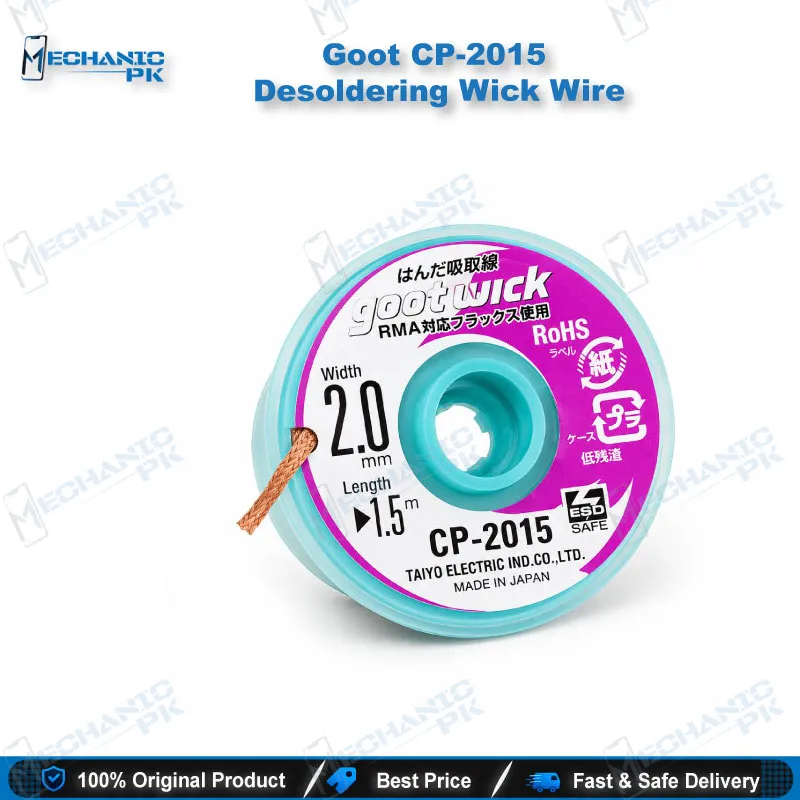
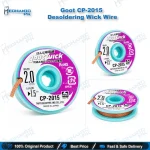
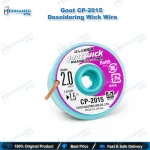
Goot CP-2015 Desoldering Wick 2.0mm x 1.5m
₨ 400
Goot CP-2015 Desoldering Braid
The Goot CP-2015 desoldering wick is a braided copper strip, about 2.0mm wide and 1.5m long, saturated with RMA-base flux. It removes lead-free solder from phone board pads, connector pins, and IC footprints when you press it against the joint with a hot iron. Taiyo Electric Industry makes it in Japan under the Goot brand. Use it after an IC change karna job, a charging port swap, or a jumper lagana repair to flatten pads and clear solder bridges before you refit parts. This desoldering braid for mobile repair Pakistan workshops fits any soldering station or hot air workflow and stays compact enough for a bench drawer.
In stock
Goot CP-2015 Desoldering Wick for Clean Pad Preparation
The Goot CP-2015 desoldering wick gives you a 2.0mm braided copper strip with RMA-base flux, built for lead-free solder removal. Taiyo Electric Industry manufactures the Goot brand in Japan, and the CP-2015 sits in a range that runs from roughly 1.0mm to 3.5mm widths. On a mobile repair bench, you reach for it after every IC change karna job and every hardware fault repair that leaves excess solder on the pads. Each piece measures about 1.5m, so one strip covers many boards before you run out.
How the Braid Pulls Solder Off the Board
Press the braid flat against the soldered joint, then touch it with a hot soldering iron tip. The solder melts and flows into the braid, and you lift the wick and the iron away together. Cut off the used section with nippers and move to a fresh length for the next joint. The flux inside the braid is non-chlorine and wash-free, and Goot positions it as safe for precision PCB work. You keep pads bright and flat, which matters when a charging issue board needs a clean footprint for a new connector.
Where It Fits in a Phone Repair Workflow
Hot air removal lifts the IC or connector, but it leaves uneven solder on the pads. The CP-2015 flattens those pads so a replacement part sits level. Technicians also use it to clear solder bridges between fine pins on FPC connectors, battery connectors, and charging port pads. Pair it with a soldering station for controlled heat, a microscope to check pad condition, and a PCB holder to keep the board steady. After wicking, you wipe the pads and test continuity with your multimeter before moving on to a reballing kit or a fresh part. A dead phone with a lifted pad or a bridged line often needs exactly this step before any further diagnosis.
Choosing the Right Width in the Goot CP Range
Goot sells the same braid in approximately 1.0, 1.5, 2.0, 2.5, 3.0, and 3.5mm widths. The 2.0mm CP-2015 gives you a practical middle size. It covers connector pins and mid-size pads without overheating the surrounding area, and it holds enough solder per pass to cut your repetitions. For very fine pitch pads, step down to the narrower CP-1515 or CP-1015. For large shield frames or heavy ground pads, step up to the wider models. Keeping two widths on your bench handles most board-level jobs.
| Weight | 0.1 kg |
|---|
Key Features
- Braided copper construction, approx. 2.0mm wide
- Approx. 1.5m length per piece
- Saturated with RMA-base flux
- Non-chlorine flux for precision PCB work
- Designed for lead-free desoldering
- Made in Japan by Taiyo Electric Industry
- Thin flat braid for efficient heat transfer
- Anti-static braid
Specifications
| Brand | Goot |
|---|---|
| Model | CP-2015 |
| Category | Desoldering Wick / Desoldering Braid |
| Compatibility | Works with any soldering iron or soldering station (universal, not device-specific) |
| Technology | Braided copper with RMA-base flux |
| Material | Braided copper |
| Dimensions | Width approx. 2.0mm x Length approx. 1.5m |
Common Repair Uses
- Real bench scenarios where the braid removes excess solder.
- Cleaning pads after IC removal
- Flattening pads before reballing
- Clearing solder bridges between pins
- Charging port replacement prep
- Battery connector repair
- FPC connector pad cleanup
- Lifting leftover solder after hot air work
- Resetting pads before jumper wire repair
Compatible Devices
- Universal desoldering consumable, not limited to specific phone models. Use it on any board with solder joints you can heat with a soldering iron.
- Android smartphone motherboards (all brands)
- iPhone logic boards
- Charging port solder pads
- FPC and battery connector pins
- IC footprints after hot air removal
- Shield frame and ground pad solder
- Tablet and feature phone PCBs
- Solder bridges on fine-pitch pins
FAQ
What is the product name?
What is the brand of this product?
What is the model of this product?
What is this product used for?
Which devices are compatible with this product?
Who should use this product?
Does the Goot CP-2015 work with lead-free solder?
How do I use the CP-2015 wick on a phone board?
Related products