















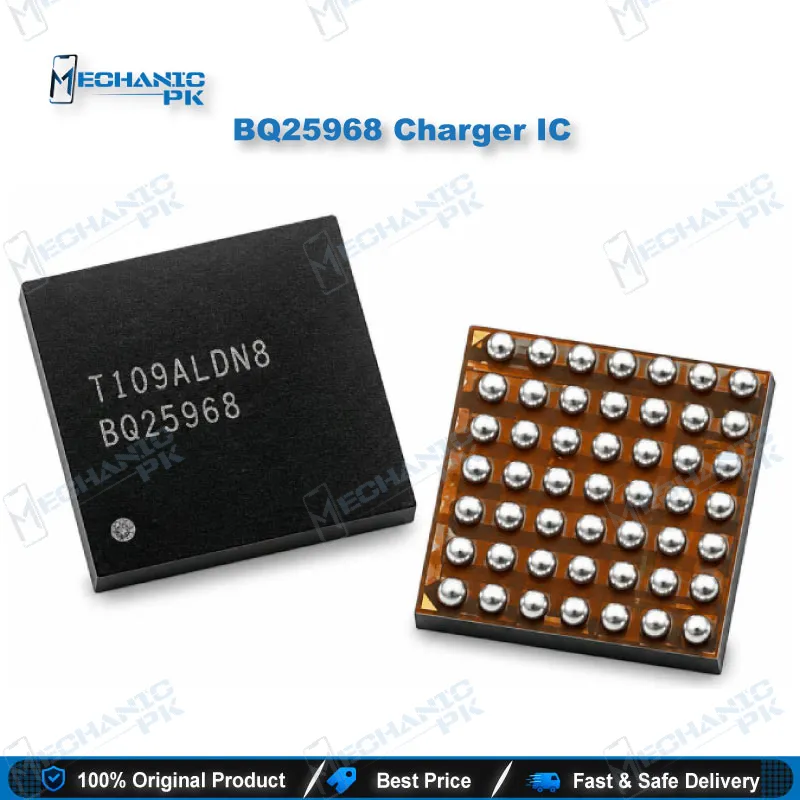
BQ25968 Charging IC 6A Switched Cap Fast Charger TI
₨ 500
H2: BQ25968 Charging IC for Single-Cell Fast Charging Repair
The BQ25968 charging IC from Texas Instruments runs the high-current stage of fast charging in single-cell Li-ion and Li-polymer phones. TI rates its dual-phase switched cap power stage at 97% efficiency for charge currents up to 6 A. The chip takes an input of twice the battery voltage and delivers twice the input current to the cell, so the cable carries half the battery current. It works beside a main switching charger such as the BQ25890 or BQ25790 under I2C control from the host. Choose it when you trace a fast charging fault to a damaged switched cap stage and need a clean IC change.
H2: BQ25968 Charging IC: TI’s 6A Switched Cap Fast Charger for Single-Cell Phones
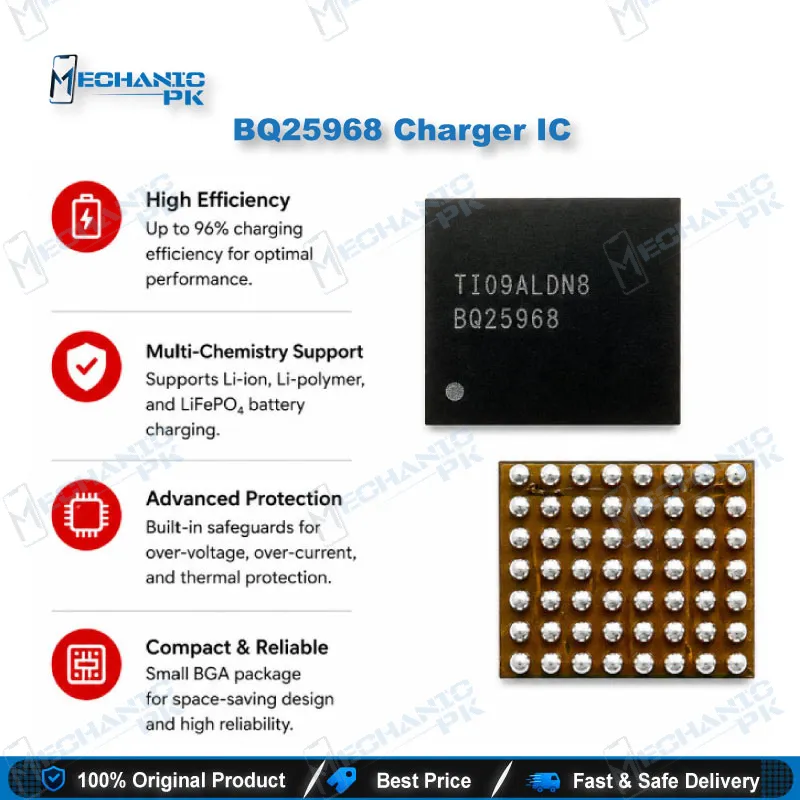
The BQ25968 charging IC from Texas Instruments handles the high-current stage of fast charging in single-cell Li-ion, Li-polymer, and LiFePO4 devices. TI rates the switched cap power stage at 97% efficiency for charge currents up to 6 A. The chip runs at a fixed 50% duty cycle, so it takes an input of twice the battery voltage and delivers twice the input current to the cell. The charging cable carries only half the battery current, which cuts cable loss and keeps the charging area cooler. The BQ25968 never works alone. It acts as a slave charger beside a main switching charger such as the BQ25890 or BQ25790, and the host processor hands charging over to it once the smart adapter negotiates the fast-charge profile. For a technician, that split decides where you look first when a fast charging fault reaches your bench.
H3: How the BQ25968 IC Works Inside the Fast-Charge Path
TI builds a dual-phase, parallel-series switched cap power stage with integrated FETs into this chip. Two phases share the load, which trims input and output capacitor requirements and lowers output ripple on the battery line. The BQ25968 accepts an operating bus input from 3.2 V to 12 V, tolerates 20 V absolute maximum, and supports an external OVP FET on the VAC line up to 17 V. Battery-side regulation covers 3.5 V to 4.65 V. The phone’s application processor controls everything over I2C: it writes protection thresholds and alarms first, then disables the main switching charger and enables the BQ25968. During charging, the host watches the alarms and keeps talking to the smart adapter to adjust delivered current. For higher-power designs, two BQ25968 chips run in parallel using master and slave modes.
H3: Protection and ADC Monitoring in the 56-Ball DSBGA Package
The BQ25968 comes in a 56-ball DSBGA (YFF) package and carries a full protection set: input overvoltage (BUS_OVP), input overcurrent (BUS_OCP) with an adjustable alarm, battery overvoltage (BAT_OVP), battery overcurrent (BAT_OCP), output overvoltage (VOUT_OVP), and a cycle-by-cycle current limit on the switching MOSFETs. Separate inputs track battery temperature and connector temperature, and an internal sensor watches die temperature. An integrated 16-bit ADC with a minimum 12-bit effective resolution reports bus voltage, bus current, output voltage, battery voltage, battery current, and all three temperatures to the host. TI specifies ±0.5% accuracy on BUS and VOUT voltage and ±1.5% on battery current at 6 A with an external sense resistor. This matters in diagnosis. When any reading crosses a threshold, firmware drops fast charging and falls back to the main charger. A damaged IC, a cracked ball, or a faulty thermistor line produces exactly that symptom.
H3: Fast Charging Fault Diagnosis and BQ25968 Charging IC Replacement
The classic complaint reaches your counter as “phone charges, but fast charging never starts.” Normal charging through the main switcher still works, so the customer blames the adapter. Start with your multimeter in diode mode on the VBUS and VOUT lines. If you find a short, inject low voltage from a DC power supply and use rosin or a thermal camera to locate the hot spot. When the BQ25968 heats up, IC change karna is the clean fix. Mount the board in a PCB holder, apply quality flux, and lift the chip with your hot air station at a controlled temperature to protect nearby capacitors. Clean the pads with your soldering station and wick, then inspect under a microscope before you place the new chip. A 56-ball part punishes poor alignment, so a reballing kit with the correct stencil helps when a pad needs fresh solder. For shops handling daily board-level charging work, an upgrade to a BGA rework station with bottom preheat gives you repeatable results on every charging section job.
| Weight | 0.1 kg |
|---|
Key Features
- 97% efficient switched cap power stage for 6 A fast charging
- 50% duty cycle architecture: input equals 2x battery voltage, output current equals 2x input current
- Dual-phase design reduces capacitor requirements and output ripple
- Input protection: BUS_OVP, BUS_OCP with alarm, external OVP FET support up to 17 V
- Battery and output protection: BAT_OVP, BAT_OCP, VOUT_OVP, cycle-by-cycle current limit
- Battery, connector, and die temperature monitoring
- Integrated 16-bit ADC for voltage, current, and temperature readings
- Master and slave parallel operation for higher-power designs
Specifications
| Brand | Texas Instruments |
|---|---|
| Model | BQ25968 (56-ball DSBGA, YFF package) |
| Category | Charging IC / Battery Charger IC |
| Compatibility | Single-cell Li-Ion, Li-Polymer, and LiFePO4 batteries |
| Supported Devices | Single-cell devices using a switched cap fast-charging architecture with a main switching charger |
| Technology | Dual-phase switched cap (charge pump) fast charger, I2C controlled, integrated 16-bit ADC |
| Input Voltage | 3.2 V to 12 V operating (20 V absolute maximum) |
| Output Voltage | 3.5 V to 4.65 V battery charge voltage |
| Power Rating | 6 A maximum charge current, 97% peak efficiency |
Common Repair Uses
- Board-level charging section repair where the switched cap stage fails.
- Fast charging not working while normal charging still works
- Slow charging caused by a damaged switched cap stage
- Short on the VBUS or VOUT line traced to the charging IC
- Overheating near the charging section during charging
- Charging issue after water damage or corrosion under the IC
- Replacement after an overvoltage event from a faulty adapter
- Charging section rebuild after reballing or board rework
- Dead phone with a shorted battery-side line traced to the charging IC
Compatible Devices
- Verified at architecture and chipset-family level; TI does not publish phone-model compatibility for this part.
- Single-cell Li-Ion smartphones with switched cap fast charging
- Single-cell Li-Polymer battery devices
- Single-cell LiFePO4 battery devices
- Charging designs paired with the TI BQ25890 main charger
- Charging designs paired with the TI BQ25790 main charger
- BQ2589x family based charging systems
- Devices charged from smart wall adapters and power banks
- Dual BQ25968 parallel designs for higher charging power
FAQ
What is the product name?
What is the brand of this product?
What is the model of this product?
What is this product used for?
Which devices are compatible with this product?
Who should use this product?
Why does fast charging stop while normal charging still works on a BQ25968 board?
What input voltage does the BQ25968 need for fast charging?
Related products