















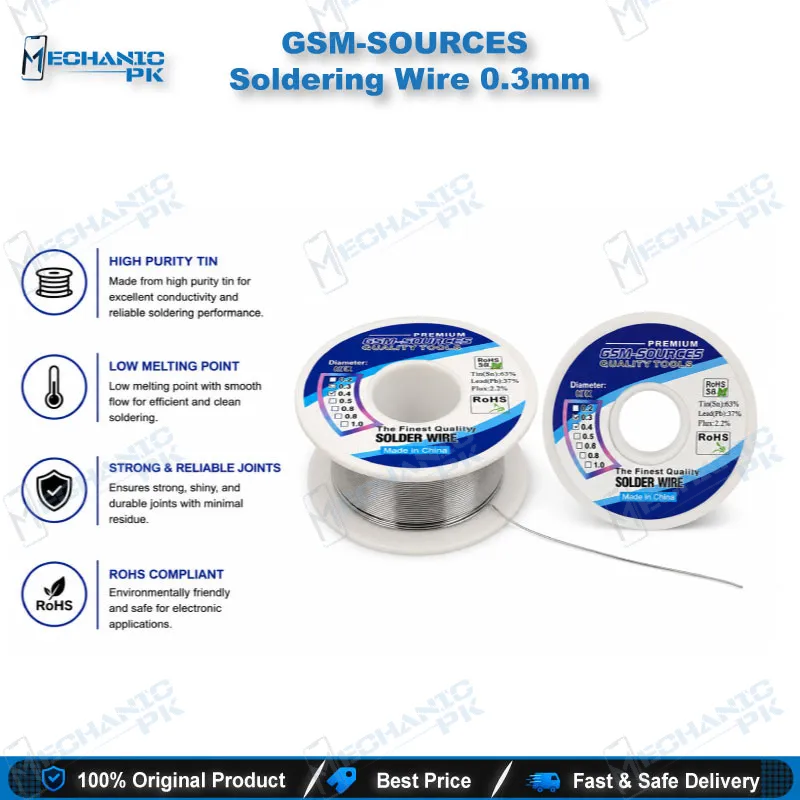
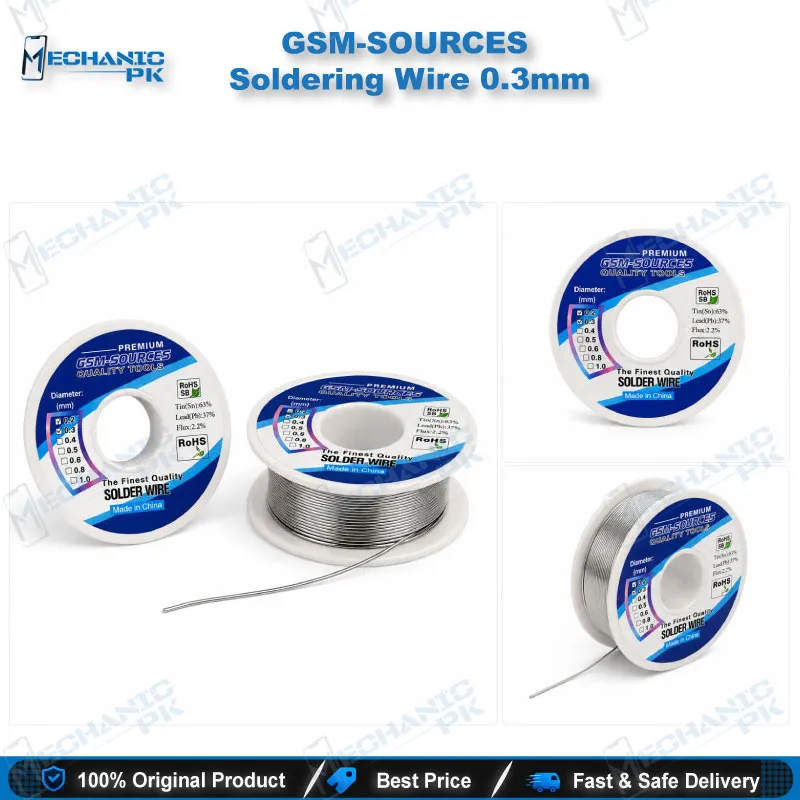
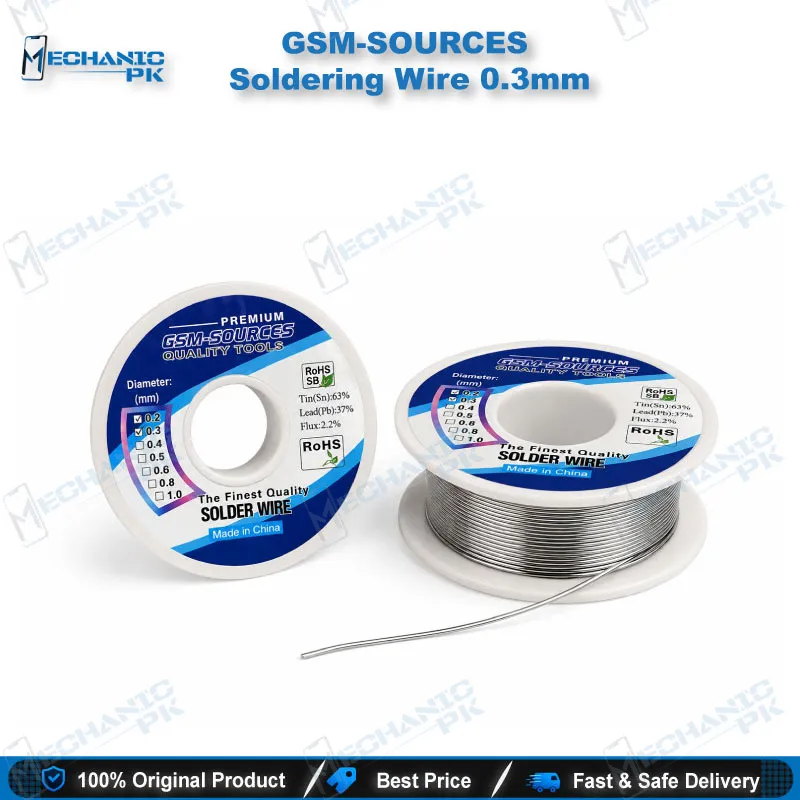
GSM-SOURCES 0.3mm Soldering Wire 63/37 for Mobile Repair
₨ 400
0.3mm Soldering Wire for Fine Pad Work
The GSM-SOURCES 0.3mm Soldering Wire gives you a thin 63/37 tin-lead feed for precise board-level work. Use it to tin charging port pads, lay jumpers across broken traces, and prepare IC pads before you seat a new chip. The fine diameter lets you control how much solder lands on each joint, so you avoid bridging neighbouring pads on a crowded phone motherboard. Mechanicpk supplies this spool to technicians and repair shops across Pakistan who handle dead phone cases, charging issues, and hardware faults every day. Pair it with your soldering station, hot air station, and microscope for a complete bench setup.
In stock
Fine 0.3mm Soldering Wire for Board-Level Repair
You reach for 0.3mm soldering wire for mobile repair when the pad in front of you is smaller than a pinhead. The GSM-SOURCES 0.3mm Soldering Wire gives you a thin 63/37 tin-lead feed, so you control exactly how much solder lands on each joint. On a crowded phone motherboard, one extra blob bridges two pads and turns a simple repair into a dead phone. A fine wire removes that risk before it starts. Mechanicpk stocks this spool for technicians and repair shops that work at board level every day.
Why 63/37 Alloy Suits Phone Motherboards
63/37 tin-lead sits at the eutectic point, so the alloy melts at a single temperature of 183°C instead of passing through a pasty range. You feel the difference at the bench: the wire flows the moment your iron tip touches the joint, and the joint sets quickly once you pull the heat away. That short transition window cuts the chance of a disturbed joint when your hand moves a fraction too early. Lead-free alloys melt at higher temperatures, so 63/37 lets you run lower iron settings and puts less thermal stress on thin boards and delicate pads. Smooth, shiny joints also read clearly under a microscope, which helps you judge whether a hardware fault comes from your repair or from the board itself. Lead-based solder needs ventilation and careful handling, so run a fume extractor and wash your hands after a long session.
Where 0.3mm Wire Fits in Your Repair Workflow
Fine wire earns its place on the jobs where thick wire fails. You tin the pads of a charging port before you seat a new connector, which fixes a charging issue without bridging the neighbouring pins. You lay a jumper across a broken trace, a routine jumper lagana job after liquid damage, and the thin wire keeps the joint small enough to sit under a shield or a strip of tape. When you plan an IC change karna on a small package, you tin the exposed pads first and level them so the new chip seats flat. Flex connector pads for display, battery, and fingerprint cables also demand this level of precision. For wide ground planes, shield frames, and large pads, switch to a thicker wire, because 0.3mm feeds too slowly to heat a big copper area.
Bench Handling and Buying Notes
Thin wire melts fast, so touch it to the heated joint instead of the iron tip, and pull it away as soon as the solder wets the pad. Pair it with a quality flux and keep your tip clean so the small amount of solder transfers properly. Store the spool away from moisture and dust to keep the surface bright. You build a complete board-level setup around this wire: a soldering station or hot air station for heat control, a microscope for inspection, a PCB holder for stable work, a multimeter for continuity checks after each repair, and a reballing kit when the job moves to BGA chips. Workshops that run several repairs a day often keep more than one spool on the bench, since fine wire runs out quickly during pad work. Order a single spool for your own bench, or ask Mechanicpk about quantities for a service center.
| Weight | 0.1 kg |
|---|
Key Features
- 0.3mm fine diameter for precise solder control on small pads
- 63/37 tin-lead eutectic alloy
- Single melting point of 183°C for fast flow and fast setting
- Lower working temperature than lead-free alloys
- Suits charging port, connector, and IC pad work
- Keeps joints small enough to fit under shields
- Works with soldering stations and hot air stations
- Built for mobile phone repair benches
Specifications
| Brand | GSM-SOURCES |
|---|---|
| Category | Soldering Consumables / Solder Wire |
| Technology | 63/37 (Sn63/Pb37) tin-lead alloy solder wire, 0.3mm diameter |
| Material | Tin-lead alloy |
Common Repair Uses
- Fine-pitch soldering and pad work at board level
- Charging port pad tinning
- Jumper wire repair on broken traces
- IC pad tinning before IC change
- Flex connector pad repair (display, battery, fingerprint)
- Pad leveling before reballing
- Liquid damage board repair
- SMD component re-soldering
- Test point and small pad repair
Compatible Devices
- Universal — not device-specific; suits board-level work on any phone motherboard
- Samsung motherboards
- Oppo motherboards
- Vivo motherboards
- Infinix motherboards
- Tecno motherboards
- Xiaomi motherboards
- iPhone logic boards
- Huawei motherboards
FAQ
What is the product name?
What is the brand of this product?
What is the model of this product?
What is this product used for?
Which devices are compatible with this product?
Who should use this product?
What is the melting point of 63/37 solder wire?
Is 0.3mm soldering wire good for jumper wire and charging port pad repair?
Related products