

















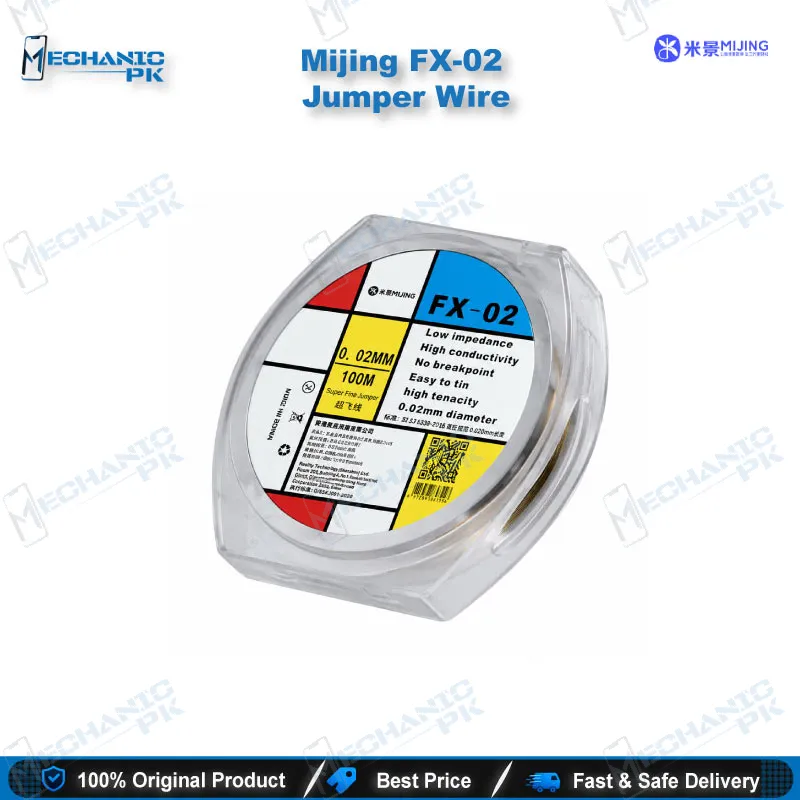



Mijing FX-02 Jumper Wire 0.02mm 100m Silver Flying Wire
₨ 950
Mijing FX-02 0.02mm Flying Jumper Wire
The Mijing FX-02 jumper wire gives your bench a 0.02mm silver flying wire on a 100m spool. You use it to bridge cut traces and rebuild lifted pads on mobile logic boards, tablet boards, and BGA pad areas where thicker wire cannot fit. The 0.02mm diameter lets you land a connection close to neighbouring pads, and the 100m length covers hundreds of repairs. Technicians pair it with a fine soldering tip, flux, and a microscope to restore broken paths after a drop, an IC change, or chip lifting. Mechanicpk stocks it for Pakistani repair shops that reorder fine wire by the spool.
In stock
Mijing FX-02 Jumper Wire for Precision Trace and Pad Repair
The Mijing FX-02 jumper wire is a 0.02mm silver flying wire wound to 100 metres, built for repairs where one lifted pad or one cut trace turns a recoverable board into a dead phone. Mechanicpk supplies it for technicians who already know that wire gauge decides whether a bridge holds. At 0.02mm, the wire reaches between pads that thicker jumper wire cannot clear, so it earns a permanent place beside your hot air station and soldering iron.
Technical Profile of the FX-02 Spool
Mijing sells the FX-02 as a 0.02mm flying jumper wire in silver, supplied as a 100m spool. The diameter is the figure that matters at the bench. It sets how close to a neighbouring pad you can land a bridge without touching it. The spool length means one purchase covers a large number of jobs, so you cut exactly what each fault needs and stop rationing centimetres. Match the wire gauge to the pad size on every repair, and check the finished joint under magnification before you power the board.
Where It Fits in Your Repair Workflow
You reach for a jumper wire after diagnosis, not before it. Set your multimeter to continuity mode, locate the open trace or the missing pad, and decide whether a bridge restores the path. Typical hardware fault jobs include a trace broken by a drop, a pad that peeled during an IC change, and a damaged pad under a BGA chip that you must reconnect after lifting it with hot air. Jumper lagana with 0.02mm wire lets you rebuild the connection from the damaged point to the nearest intact point on the board. After the bridge, you reflow lightly, clean the flux, and test under power. On charging issue boards and display problem boards with physical trace damage, a verified continuous path often brings the board back.
Handling Tips for Ultra-Fine Wire
Fine wire rewards a steady setup. Hold the board in a PCB holder, work under a microscope, and cut a short length with sharp tweezers instead of a long loop. Flux the pad first, tin the wire end lightly, and keep iron contact short so the wire does not melt back on itself. Route the wire flat along the board and keep it clear of nearby pads. Secure longer runs with a small dab of UV mask or adhesive once the joint tests good. Use a fine tip on your soldering station, because a large tip overheats this gauge within seconds and ruins the joint.
Why Technicians Stock It by the Spool
Repair shops that handle volume see pad and trace damage every week. A 100m spool on the shelf means no waiting when a board arrives with a damaged pad. Keep it alongside reballing kits, flux, solder paste, and hot air consumables, and you cover the full path from lifting a chip to restoring the pad beneath it. Mechanicpk lists the FX-02 so Pakistani repair shops reorder the same spool and the same gauge, which keeps your results consistent from one repair to the next.
| Weight | 0.3 kg |
|---|
Key Features
- 0.02mm ultra-fine diameter for tight pad spacing
- Silver flying jumper wire
- 100m spool length for high-volume repair shops
- Suits micro-soldering on mobile and tablet boards
- Works with continuity-based fault finding on traces
- Fits CPU, BGA, and IC pad rebuilds
- Cuts to exact lengths per repair
- Pairs with microscope, fine tip, and flux workflow
Specifications
| Brand | Mijing |
|---|---|
| Model | FX-02 |
| Category | Jumper Wire / Mobile Repair Soldering Accessories |
| Compatibility | Universal – not device-specific |
| Dimensions | 0.02mm wire diameter, 100m length |
Common Repair Uses
- Bridging damaged paths on mobile and tablet boards during micro-soldering
- Bridging cut or burnt traces
- Rebuilding lifted pads after IC change
- Reconnecting damaged BGA pads after chip lifting
- Repairing pads damaged by heat during rework
- Fixing broken paths found by continuity testing
- Charging issue trace repair
- Display problem line repair
- Micro-soldering practice for technician training
Compatible Devices
- Universal – not device-specific; used on any board where a 0.02mm bridge suits the pad size
- Android smartphone logic boards
- iPhone logic boards
- Tablet and iPad motherboards
- CPU and BGA pad areas
- IC pads after chip removal
- Fingerprint sensor pad areas
- Broken trace points on multilayer boards
- Small surface-mount pad repairs
FAQ
What is the product name?
What is the brand of this product?
What is the model of this product?
What is this product used for?
Which devices are compatible with this product?
Who should use this product?
What diameter and length does the Mijing FX-02 jumper wire have?
How do I solder 0.02mm jumper wire without breaking or melting it?
Related products