














One-Stop OS-G1 Explosion-Proof Tin Glass for BGA Reballing
Original price was: ₨ 400.₨ 250Current price is: ₨ 250.
Explosion-Proof Tin Glass for Reballing
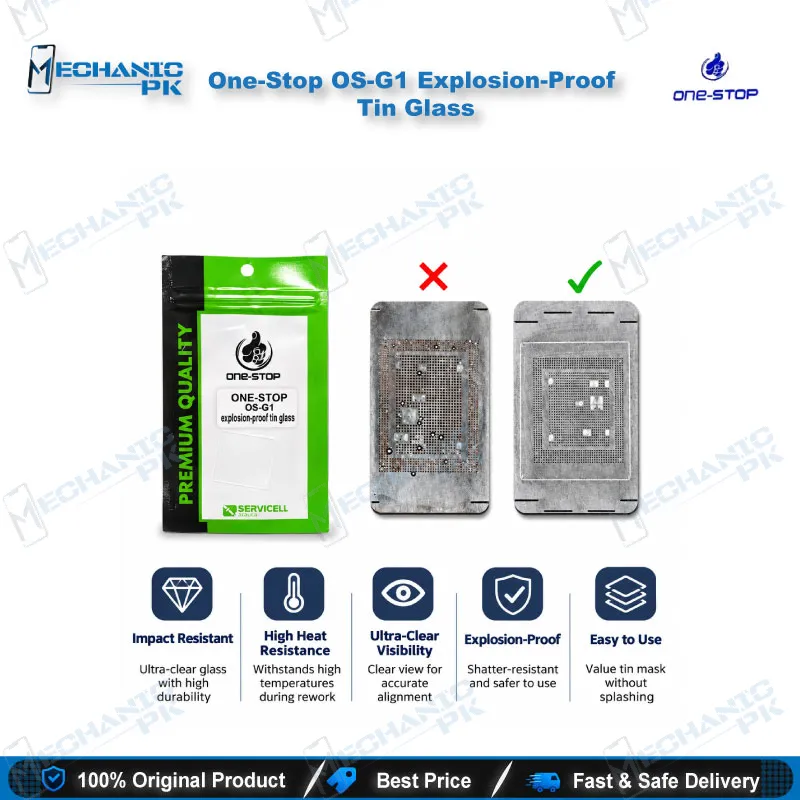
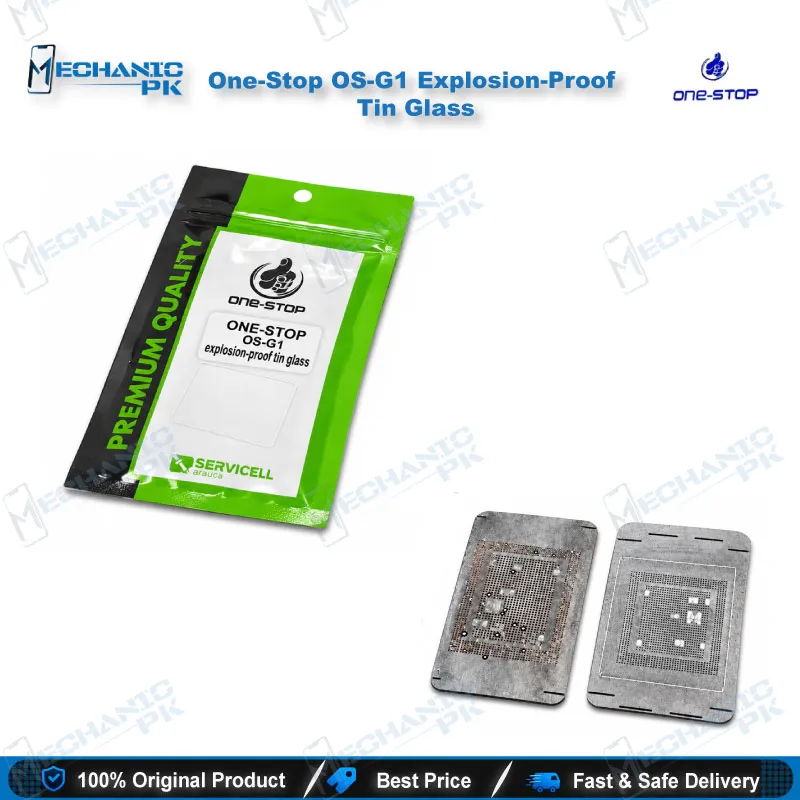
The One-Stop OS-G1 Explosion-Proof Tin Glass is a 20 x 20 x 1 mm sheet of ultra-white explosion-proof glass that sits on top of your steel mesh BGA stencil during tin planting. It spreads pressure evenly across the stencil face, reduces stencil bulging, and cuts down solder ball burst and tin splatter while you heat PM ICs and CPU pads. You clean the sheet after each job and reuse it on the next board. It suits repair benches, service centers, and training institutes that run PM IC and CPU reballing every day.
In stock
OS-G1 Explosion-Proof Tin Glass for Controlled BGA Reballing
Explosion-proof tin glass for BGA reballing solves a problem every board-level technician meets sooner or later. You align a steel mesh stencil on a PM IC or CPU, load the tin, apply heat, and the stencil bulges while solder balls burst and scatter across the board. The One-Stop OS-G1 Explosion-Proof Tin Glass puts a flat, rigid sheet of ultra-white glass on top of the stencil, so pressure spreads evenly across the stencil face instead of building up in one spot. At 20 x 20 x 1 mm, the sheet covers the compact BGA footprints you handle on a mobile motherboard and adds a protective layer to your reballing setup.
Key Technical Highlights
The OS-G1 is a flat sheet of explosion-proof ultra-white glass that measures 20 mm by 20 mm with a thickness of 1 mm. One-Stop positions it as a universal accessory, so it carries no phone-model or chipset restriction. It sits on top of steel mesh BGA reballing stencils, the format technicians use for PM IC and CPU tin planting. The smooth face presses evenly on the stencil, which reduces stencil bulging and limits solder ball burst while the tin heats. The glass also reduces tin splatter on your bench and protects the stencil and the IC surface during tin application. A plain glass sheet has no moving parts, so you clean it after each job and reuse it on the next board. The 20 x 20 mm footprint suits stencil areas that fit inside it, so check your IC size against the sheet before you order.
Where It Fits in Your Reballing Workflow
Reballing follows a fixed order on the bench. You remove the IC with a hot air station, clean the pads, align the stencil, plant the tin, and heat until the balls form. The OS-G1 enters at the tin planting step. You align the stencil on the IC, lay the glass over the stencil, apply tin, and heat as usual. When the heating cycle ends, you lift the glass off, let it cool, and clean it for the next job. Let the board and the glass cool fully before you touch either.
This step matters on boards where a single displaced ball can leave you with a hardware fault, a dead phone, or a hang on logo after reassembly. A charging issue or a dead phone fault often sends you to PM IC reballing, and CPU work leaves even less room for error. Build the rest of your setup around the glass with a reballing kit, a soldering station, a PCB holder that keeps the board still, and a microscope to inspect the result before you reflow the chip onto the board. Check the glass for chips or cracks before every use, and retire any sheet that shows damage.
Why Technicians Choose This Tool
Tin splatter costs time on every reballing job. Stray tin balls land on the board, on the stencil, and on your bench, and you spend minutes picking them off before you can trust the result. A glass cover reduces that splatter and keeps the mess off the IC surface during tin application. Stencil deformation costs more. A bulged steel mesh stencil stops sealing against the IC, and you lose a tool you paid for. By limiting that bulging, the OS-G1 protects the stencil you already own.
Because you can reuse the sheet with proper cleaning, one piece covers many jobs on a busy bench. Repair shops, service centers, and training institutes that run PM IC and CPU reballing every week get a simple accessory that fits any stencil workflow without model-specific setup. Browse the Reballing Kits, Hot Air Stations, Soldering Stations, Microscopes, and PCB Holders categories at Mechanicpk to complete the bench around it. Keep a spare sheet next to your stencils, because a cracked or scratched piece should never go back on a stencil mid-job.
| Weight | 0.10 kg |
|---|
Key Features
- Explosion-proof ultra-white glass construction
- 20 x 20 x 1 mm flat sheet
- Spreads pressure evenly across the stencil face
- Reduces steel mesh stencil bulging
- Reduces solder ball burst during heating
- Reduces tin splatter on the board and bench
- Protects the stencil and IC surface during tin application
- Reusable with proper cleaning
Specifications
| Brand | One-Stop |
|---|---|
| Model | OS-G1 |
| Category | BGA Reballing Accessories |
| Compatibility | Universal, not device-specific; works over steel mesh BGA reballing stencils |
| Material | Explosion-proof ultra-white glass |
| Dimensions | 20 x 20 x 1 mm |
Common Repair Uses
- Tin planting through a stencil during BGA reballing on mobile phone boards
- Tin planting on PM ICs through a steel mesh stencil
- Tin planting on CPU BGA pads
- Reducing solder ball burst during heating
- Reducing steel mesh stencil bulging
- Reducing tin splatter on the board and bench
- Protecting the stencil and IC surface during tin application
- Reballing PM ICs on boards with a charging issue or a dead phone fault
Compatible Devices
- Universal accessory, not device-specific; it works with steel mesh BGA reballing stencils on any phone board whose IC area fits inside 20 x 20 mm
- Universal accessory with no phone-brand or chipset restriction
- Steel mesh BGA reballing stencils
- Stencils used for PM IC reballing
- Stencils used for CPU reballing
- Any BGA IC area that fits inside the 20 x 20 mm sheet
FAQ
What is the product name?
What is the brand of this product?
What is the model of this product?
What is this product used for?
Which devices are compatible with this product?
Who should use this product?
How do you use the OS-G1 tin glass during BGA reballing?
What size is the OS-G1 tin glass and which stencils does it cover?
Related products