















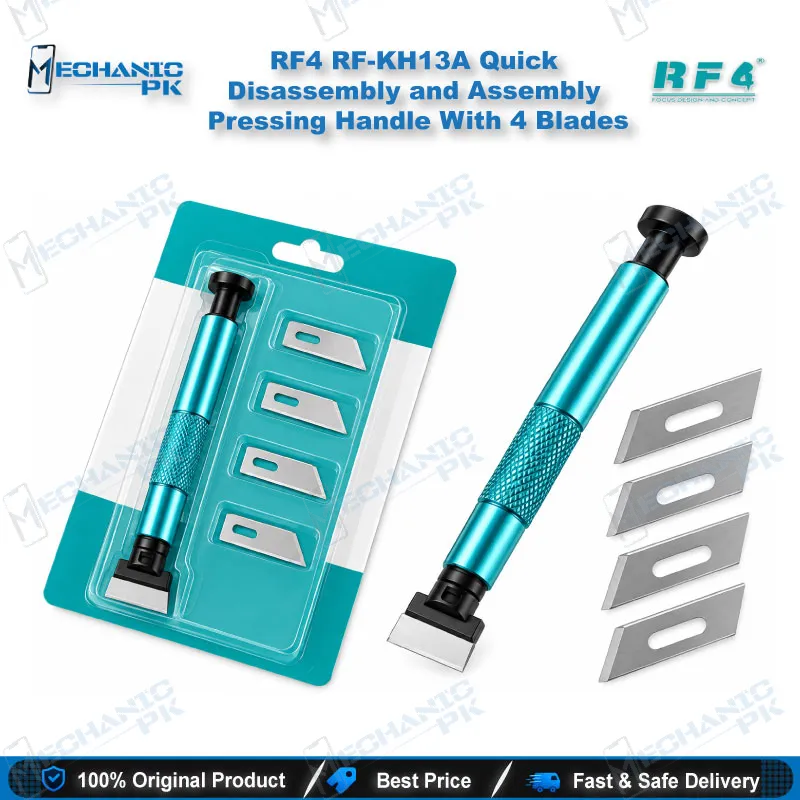
RF4 RF-KH13A Quick Disassembly and Assembly Pressing Handle
₨ 1,800
Quick-Release Blade Handle for Phone Repair
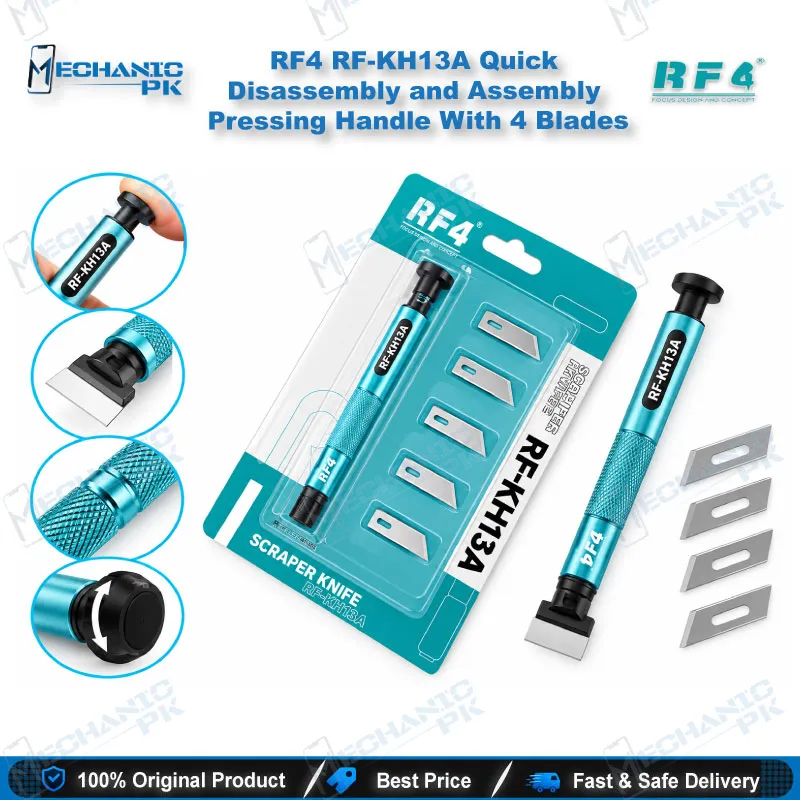
The RF4 RF-KH13A Quick Disassembly and Assembly Pressing Handle With 4 Blades gives your bench a press-to-open, release-to-lock holder and four commonly used blades in one kit. One press opens the cross-shaped clamp, you seat the blade, and the tip locks in place. The non-slip grip keeps your hand steady through long teardowns, and the locking tip holds the edge steady under pressure. Use it for adhesive cutting, solder scraping, screen removal, casing prying and CPU IC prying on phones and PCBs. Technicians who swap tips all day finish each change with a single press.
In stock
RF4 RF-KH13A Pressing Handle: Faster Tip Changes for Teardown Work
The RF4 RF-KH13A pressing handle solves a problem every bench technician knows: twist-sleeve and screw-collet holders slow you down when a single job demands a different blade every few minutes. The RF4 RF-KH13A Quick Disassembly and Assembly Pressing Handle With 4 Blades gives you a press-to-open, release-to-lock clamp and four commonly used blades in one kit. You press the handle, seat the blade, release, and the tip locks. That rhythm keeps your hands on the board instead of on the tool.
How the Press-to-Open Clamp Holds a Blade
The mechanism follows the RF-KH13 series design: pressing the handle opens a cross-shaped clamp, and releasing it closes the clamp around the tip. The cross-shaped opening accepts tips of various thicknesses, so the clamp grips thin and thick blades without a separate adapter. A locking blade tip keeps the edge steady while you apply pressure, which matters when you cut through adhesive or pry a component that sits tight on the board.
The body uses aluminum alloy, so the handle stays light enough for precise work and rigid enough for sustained pressure. A soft foam grip sleeve and a non-slip surface reduce hand fatigue during long disassembly sessions. Check blade fit before a critical job, because the listing confirms the clamp handles various thicknesses but does not publish a fixed blade size range.
Where It Fits in Your Repair Workflow
Most board-level jobs start with access. You separate the screen, cut the adhesive that holds the mid-frame, and pry the casing before any soldering begins. The RF-KH13A covers those opening steps and the cleanup that follows. On a phone with a display problem, you lift the screen edge, cut the adhesive line, and swap to a scraping blade for the frame without leaving the handle. On a dead phone or a charging issue, you clear glue around the suspect area so you can inspect the board under a microscope and probe test points with a multimeter.
The handle also supports component-level preparation. When an IC sits under hardened glue, you scrape the residue and pry carefully before you move to a hot air station or a soldering station. Technicians who work on eMMC and UFS chips use the same approach: clear the glue first, then continue with ISP pinout tools, eMMC programmers or UFS adapters. After an IC comes off, you scrape old solder from the pads and prepare the board for a reballing kit. A PCB holder keeps the board still while you work, and the press handle keeps the blade change quick when you switch tasks.
Why Technicians Choose a Quick-Release Handle
A repair shop in Pakistan that processes screen replacements, charging port jobs and hardware fault diagnosis every day changes tips hundreds of times a month. Each swap with a twist-style holder costs seconds, and those seconds add up across a full day. The quick-release handle cuts each swap to a single press. You also stop losing small parts: a collet cap rolls off the bench, a press handle does not.
The kit suits several buyer types. A solo technician gets a complete starter set for glue removal and prying. A multi-technician shop can issue one handle per bench and standardize how the team opens phones. Training institutes get a simple, repeatable tool that students learn in minutes. Pair it with a microscope and a stable PCB holder, and you cover the full path from opening the phone to a clean board ready for rework.
The RF-KH13A stays a manual hand tool, so it needs no power supply, no calibration and no software. You carry it, press it and use it. That simplicity makes it a dependable partner for the heavier equipment on your bench, from hot air stations to test boxes.
| Weight | 0.15 kg |
|---|
Key Features
- Press-to-open, release-to-lock mechanism for quick tip swaps
- Cross-shaped opening that holds tips of various thicknesses
- Locking blade tip that stays steady under pressure
- Four commonly used blades in the kit
- Aluminum alloy body for a light, rigid hold
- Soft foam grip sleeve that reduces fatigue
- Non-slip grip for long disassembly sessions
- Covers glue removal, solder scraping, casing prying and CPU IC prying
Specifications
| Brand | RF4 |
|---|---|
| Model | RF-KH13A |
| Category | Mobile Repair Blades and Disassembly Tools |
| Compatibility | Universal hand tool, not device-specific |
| Technology | Press-to-open, release-to-lock quick-release clamp with cross-shaped tip opening |
| Material | Aluminum alloy body with soft foam grip sleeve |
| Blades Included | 4 commonly used blades |
Common Repair Uses
- Opening, cleaning and preparing phones and boards for repair.
- Screen removal on phones with a display problem
- Cutting and removing adhesive along frames and edges
- Prying open phone casings
- Scraping solder from PCB pads
- CPU IC prying during board-level repair
- Glue removal around ICs before hot air or soldering rework
- Board cleaning during PCB repair on a dead phone or charging issue job
- Fast blade swaps between teardown, scraping and prying steps
Compatible Devices
- Universal hand tool. It works on any phone or board where you need adhesive cutting, scraping or prying, and does not tie to a brand or model.
- Universal use: not limited to a phone brand, model or chipset family
- Smartphone screens and display assemblies
- Smartphone casings and back covers
- Adhesive-sealed mid-frames
- Mobile phone mainboards (PCB) for glue and solder scraping
- CPU and IC surfaces that need careful prying
- Other blade tips that fit the cross-shaped opening
- Other small electronics that need adhesive cutting or casing prying
FAQ
What is the product name?
What is the brand of this product?
What is the model of this product?
What is this product used for?
Which devices are compatible with this product?
Who should use this product?
How does the RF-KH13A press mechanism hold the blade?
Can the RF-KH13A handle hold blades other than the four included?
Related products